Category
879 places
Your location is only used in your browser to sort nearby places; it is never stored.
879 places listed
Castle
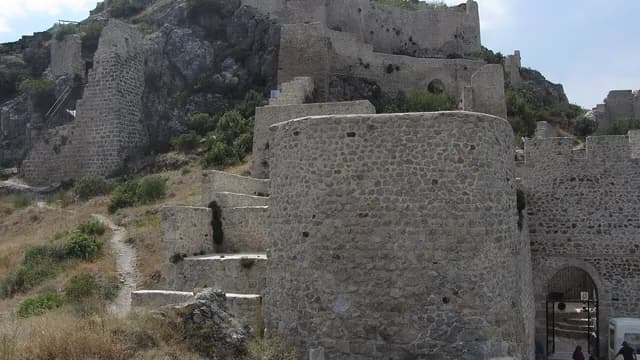
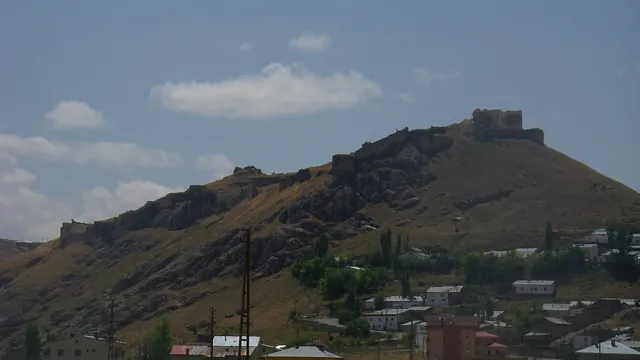
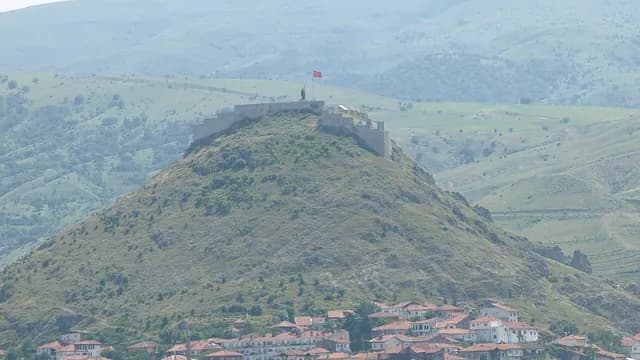
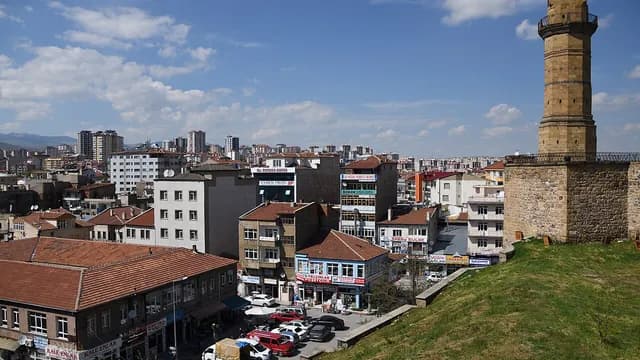
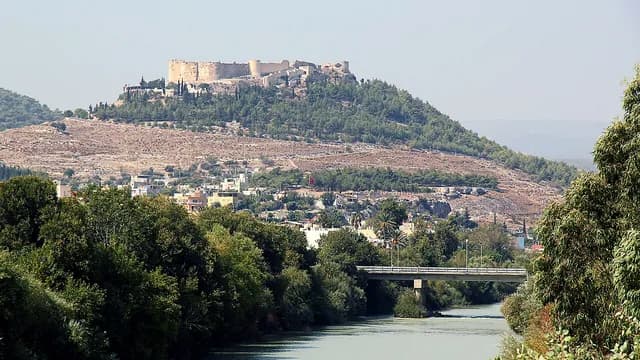
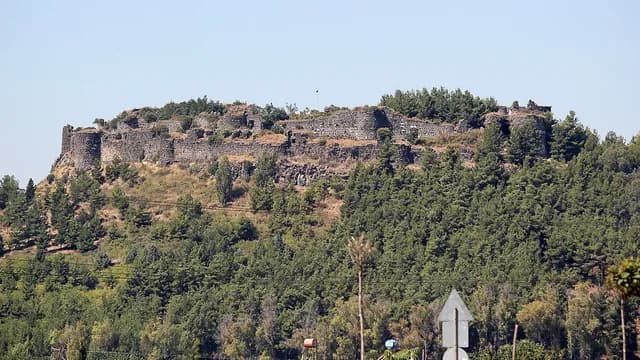
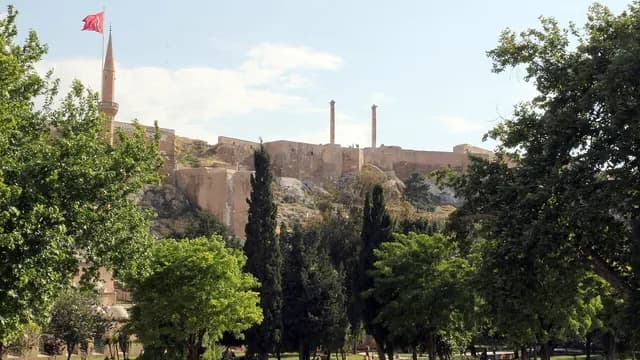
Afyonkarahisar Castle
Merkez, Afyonkarahisar
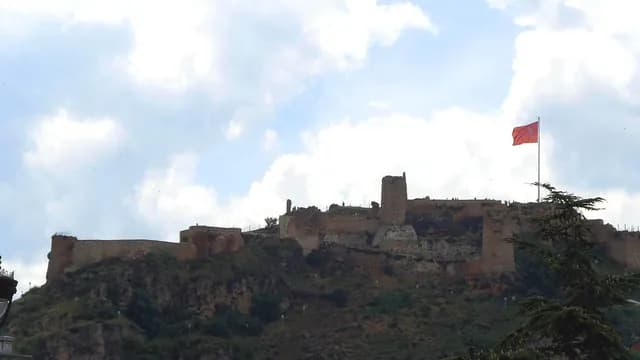
The castle on a volcanic rock rising 226 m in the middle of the city; used from the Hittites to the Ottomans, it gave the city its name.
Bridge
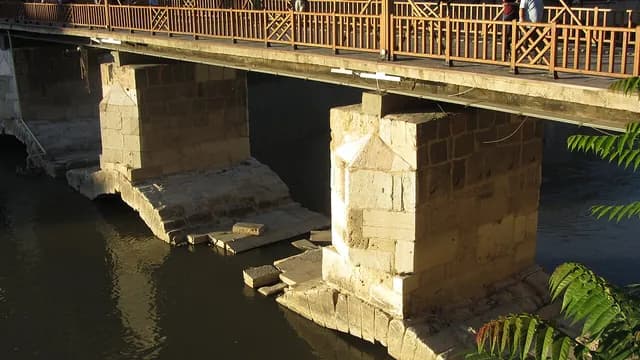
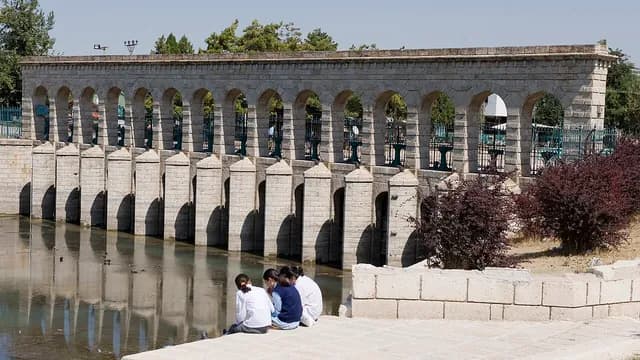
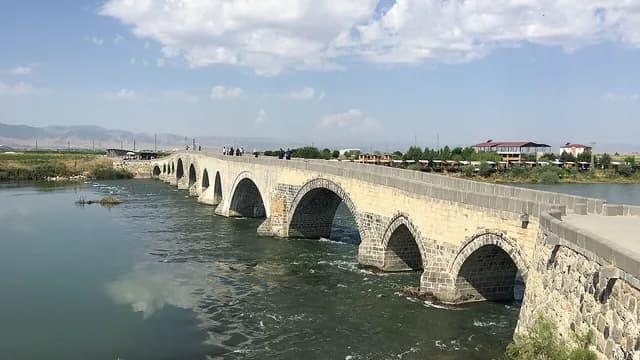
Altıgöz Bridge
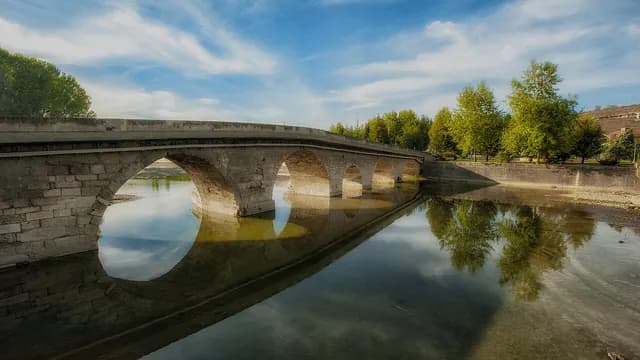
A six-arched Seljuk stone bridge over the Akarçay, given its present form by a restoration in 1237.
Ancient city
Amorium Ancient City
Emirdağ, Afyonkarahisar
A Phrygian city that flourished on Byzantium's military road and declined after the Arab sack of 838; excavations continue at Hisarköy.
Apameia Kibotos (Kelainai) Ancient City
Dinar, Afyonkarahisar
Apameia, built over the Persian satrapal center of Kelainai, one of the region's largest cities after Ephesus.
History and archaeology
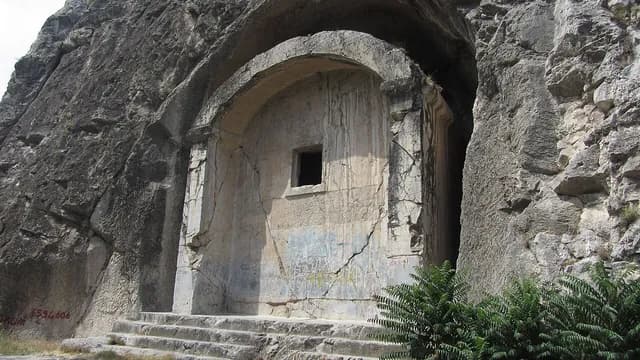
Aslankaya Temple
İhsaniye, Afyonkarahisar
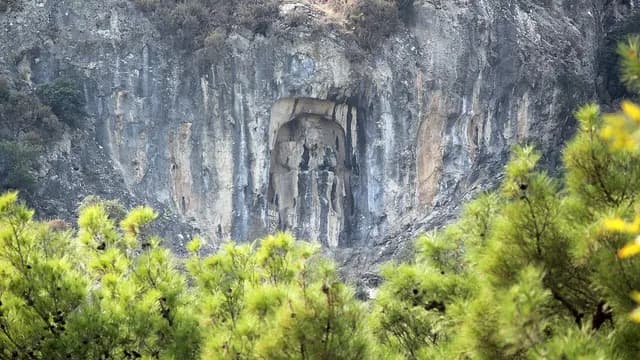
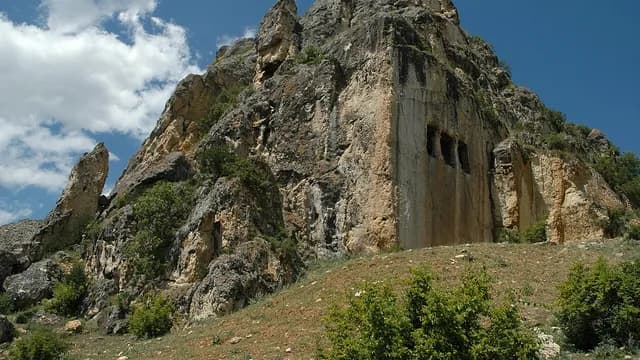
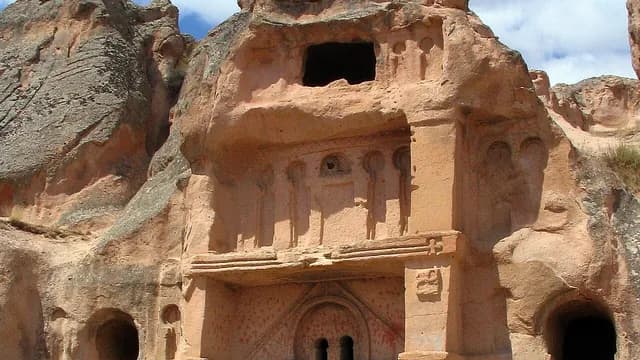
A Phrygian rock façade with a triangular pediment and sphinx and lion reliefs, near Emre Gölü.
Rock tomb
Aslantaş and Yılantaş Rock Tombs
Phrygian rock tombs comprising Aslantaş, with giant lion reliefs on its façade, and the toppled Yılantaş.
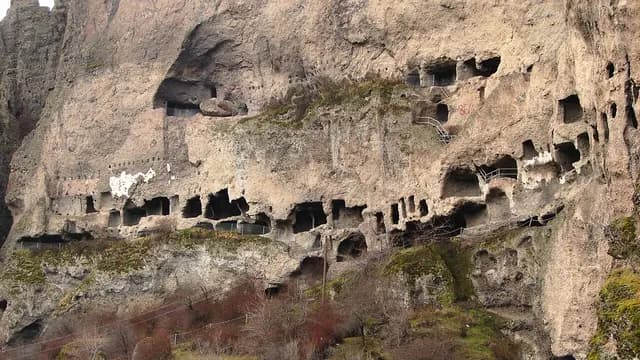
Ayazini Rock Settlement
A historic village in the Afyon section of the Phrygian Valley, full of rock-carved houses, churches and burial chambers.
Monument and statue
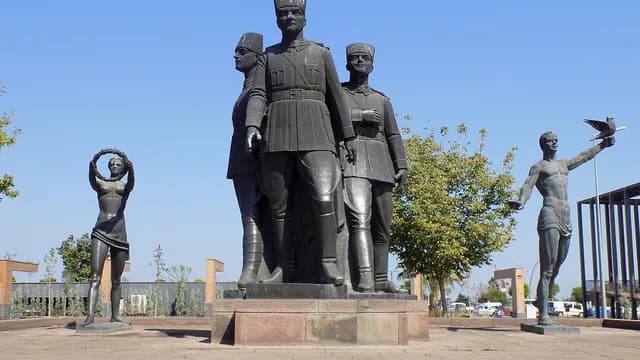
Büyük Utku (Victory) Monument
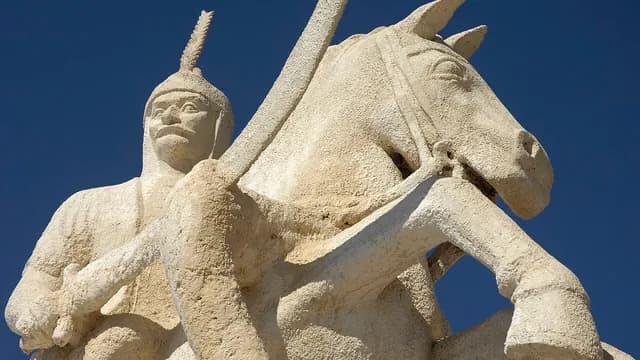
Bronze monument made by Heinrich Krippel in 1934-1936, symbolizing the Great Offensive and the city's liberation.
Han and caravanserai
Çay Han (Taşhan)
Çay, Afyonkarahisar
A Seljuk caravanserai on the Konya road, commissioned in 1278 by the same patron as the Taş Medrese.
Martyrs' memorial and battlefield
Çiğiltepe Martyrs' Memorial
Sinanpaşa, Afyonkarahisar
Martyrs' memorial and monument to Colonel Reşat Bey, who took his own life when he could not take Çiğiltepe within the time he had promised during the Great Offensive.
Döğer Caravanserai
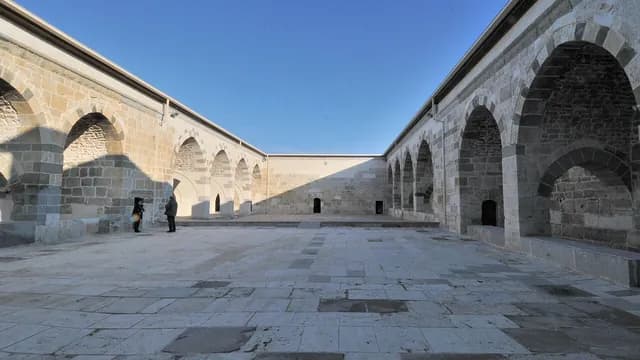
An Ottoman caravanserai in the town of Döğer at the entrance to the Phrygian Valley.
Archaeological site
Dokimeion Ancient City and Marble Quarries
İscehisar, Afyonkarahisar
Ancient quarries and city where the purple-veined "pavonazzetto," one of Rome's most valuable marbles, was extracted.
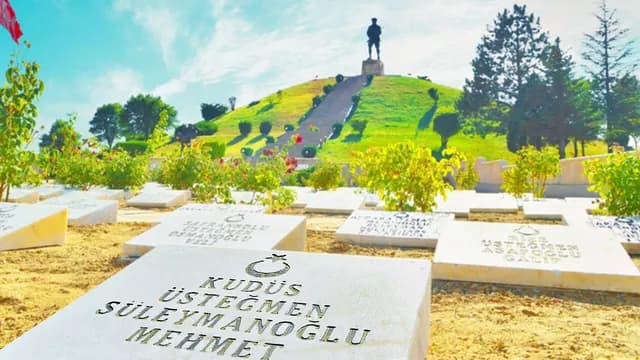
Great Offensive Martyrs' Cemetery
A monumental martyrs' cemetery with symbolic gravestones, built in memory of the 275 officers and 2150 soldiers who fell in the Great Offensive.
Ipsus Battlefield
The ancient Phrygian town where the decisive Battle of Ipsus between the successors of Alexander the Great took place in 301 BC.
İshaklı (Sahip Ata) Caravanserai
Sultandağı, Afyonkarahisar
A Seljuk caravanserai on the Afyon-Konya road, commissioned in 1249 by the vizier Sahip Ata Fahreddin Ali.
Kırkgöz Bridge
Bolvadin, Afyonkarahisar
A long stone bridge over the Akarçay, built in 1150 by Byzantine Emperor Manuel I, with 57 arches today.
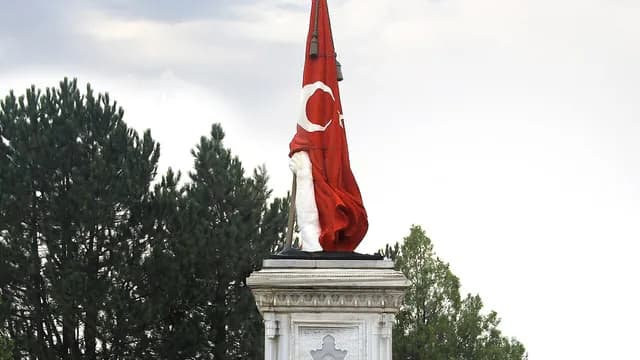
Kocatepe Atatürk Monument
The bronze Atatürk monument on 1874 m Kocatepe, from where the Great Offensive was directed on August 26, 1922.
Mound (höyük)
Kusura Mound (Höyük)
Sandıklı, Afyonkarahisar
The mound that gave its name to the schematic "Kusura-type" idols of the Early Bronze Age.
Synnada Ancient City
Şuhut, Afyonkarahisar
A Phrygia Salutaris city beneath today's Şuhut, famed for trading Dokimeion marble.
Taşhan (Hoca Üveys Han)
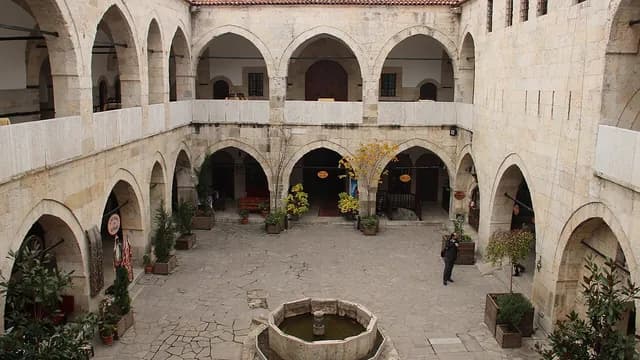
An Ottoman-era stone han in the historic bazaar district of the city center.
Acharaka Ploutonion
Sultanhisar, Aydın
A sanctuary near Nysa known for its temple of Pluto, where healing was sought in antiquity, and the "Charonion" cave.
Alabanda Ancient City
Çine, Aydın
A Carian city in Doğanyurt village, built on a saddle between two hills, with its bouleuterion standing among village houses.
Alinda Ancient City
Karpuzlu, Aydın
Queen Ada's city on the hill above Karpuzlu, with its multistory market building and theater.
Antiocheia (Antioch on the Meander)
Kuyucak, Aydın
A Carian city near Başaran village, where the Dandalaz Çayı joins the Büyük Menderes.
Aphrodisias Ancient City (UNESCO)
Karacasu, Aydın
A UNESCO World Heritage Carian city dedicated to Aphrodite, famous for its school of sculpture, the Tetrapylon and its great stadium.
Atça Martyrs' Monument
A stepped pyramid monument in Atça, inaugurated in 1946 in memory of 12 civilians killed on the Çomaklı Plain on the night of April 24, 1921.
Aurelia Neapolis
Bozdoğan, Aydın
An inland Carian settlement near Yazıkent, at the foot of ancient Mount Kadmos.
Çine-Tepecik Mound
A trade-center mound on the Çine Plain, continuously settled from the Late Neolithic to the Late Bronze Age and excavated since 2004.
Dedekuyusu (Deştepe) Mound
Efeler, Aydın
Aydın's oldest known settlement; one of the large mounds of the Büyük Menderes Plain, spanning 4500-1200 BC.
Gerga Ancient City
A mysterious Carian sanctuary in hilly terrain near Ovacık, with stone blocks inscribed "Gerga."
Güvercinada Castle
Kuşadası, Aydın
The Ottoman castle on a small island linked to the mainland by a causeway, which gave Kuşadası its name.
Harpasa Ancient City
Nazilli, Aydın
A Carian city built on a high hill near Esenköy, overlooking the Akçay valley.
Kadıkalesi (Anaia)
A medieval castle on the site of ancient Anaia, south of the Bay of Kuşadası.
Karura Ancient Settlement
Buharkent, Aydın
A settlement on the Caria-Phrygia border south of the Büyük Menderes, known in antiquity for its hot springs.
Magnesia Ancient City
Germencik, Aydın
An Ionian city near Ortaklar on the Menderes plain, with the Temple of Artemis Leukophryene and its stadium.
Malgaç Raid Monument
A monument commemorating the raid by Yörük Ali Efe and his comrades on the occupation unit at the Malgaç railway bridge on June 16, 1919.
Mastaura Ancient City
An ancient city around Bozyurt village bearing traces of two regions thanks to its location between Caria and Lydia.
Miletus Ancient City
Didim, Aydın
The city of Thales; remains of Ionia's most powerful harbor city, with its giant theater and the Baths of Faustina.
Myus Ancient City
Söke, Aydın
An Ionian League city north of Bafa Gölü, abandoned because of the Menderes alluvium.
Nysa Ancient City
A Hellenistic-Roman city among olive groves, built on both banks of a stream, known for its theater and library.
Nysa Bridge and Tunnel
A Roman tunnel-bridge structure of about 100 meters in Nysa, carrying the Tekkecik Deresi underground.
Öküz Mehmet Paşa Caravanserai
A fortress-like caravanserai facing Kuşadası harbor, commissioned by Öküz Mehmet Paşa in the early 17th century.
Orthosia Ancient City
Yenipazar, Aydın
A Carian city on the south bank of the Büyük Menderes, inhabited in the Hellenistic to Byzantine periods.
Panionion
A sanctuary on Otomatik Tepe in Güzelçamlı, known as the common meeting and festival place of the Ionian League.
Piginda (Bargasa) Ancient City
An ancient city on a hill near Çamlıdere with panoramic views of the Akçay valley.
Priene Ancient City
One of the most orderly Ionian cities, laid out on a grid on the steep slope of Mykale, with its Temple of Athena and bouleuterion.
Pygela Ancient City
A small Ionian town on the shore of the Bay of Kuşadası whose founding is linked to Agamemnon.
Temple of Apollo at Didyma
One of the greatest oracle centers of the ancient world; the Temple of Apollo in Didim with its giant columns and Medusa head.
Tralleis Ancient City
An ancient city on the plateau north of Aydın, with the gymnasium arches known as "Üç Gözler."
Akhan Caravanserai
Pamukkale, Denizli
A Seljuk caravanserai with a white stone facade on the Denizli-Afyonkarahisar road, completed in 1253-1254.
Ancient City of Dionysopolis
Bekilli, Denizli
An ancient Phrygian city near Bekilli, whose founding is attributed to the Pergamene kings Attalus and Eumenes, and which became a bishopric.
Attuda Ancient City
Sarayköy, Denizli
The remains of a small Carian city that minted coins, in Hisar village in Sarayköy.
Çardak Han (Han-ı Âbâd)
Çardak, Denizli
A 13th-century Seljuk caravanserai commissioned by Esedüddin Ayaz in the reign of Sultan Alaeddin Keykubad I.
Eumeneia Ancient City
Çivril, Denizli
An ancient Phrygian city at today's Işıklı, named after Eumenes, brother of King Attalus II of Pergamon.
Herakleia Salbake Ancient City
Tavas, Denizli
An ancient Carian city on the Tavas plateau, named after Heracles.
Hierapolis Ancient City
A Hellenistic-Roman city built on top of the Pamukkale travertines, famed for its thermal springs; highlights include its theater and vast necropolis.
Hierapolis Theater
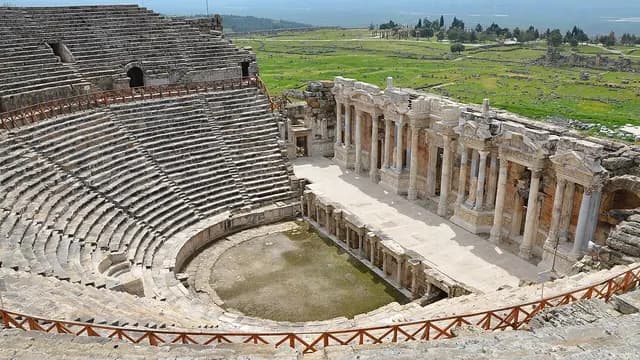
Set into the slope under Hadrian, one of the best-preserved theaters in Anatolia, with reliefs on its stage building.
Kolossai Mound
Honaz, Denizli
An ancient Phrygian city known from the Apostle Paul's Epistle to the Colossians; new excavations are under way at the mound at the foot of Honaz Dağı.
Laodikeia Ancient City
A wealthy Roman city on the Lykos (Çürüksu); one of the seven churches of the Book of Revelation, on the UNESCO tentative list.
Medet Höyüğü (Apollonia Salbake)
A mound and the city of Apollonia in Medet village on the Tavas plain, bearing uninterrupted traces from the Bronze Age to the Turkish period.
Ploutonion (Gate of Hades)
A sanctuary dedicated to Pluto, god of the underworld, described by ancient writers for its poisonous gas emissions.
Sebastopolis Ancient City
A small Carian settlement near the town of Kızılca that took the name Sebastopolis in the Roman period.
Tabai Ancient City
Kale, Denizli
An ancient Carian city on top of the Kale district center; the name Tavas comes from this city's old name.
Temple of Apollo Lairbenos
Çal, Denizli
A Roman-period sanctuary on Asartepe near Bahadınlar village, overlooking the Büyük Menderes valley.
Trapezopolis Ancient City
Babadağ, Denizli
A small city at the Boludüzü locality near Bekirler village, part of the province of Phrygia Pacatiana in the late Roman period.
Tripolis Ancient City
Buldan, Denizli
A trading city on the borders of Lydia, Phrygia and Caria overlooking the Büyük Menderes valley, with its theater and streets opened by excavation.
Agora of Smyrna
Konak, İzmir
In the city center, one of the best-preserved agoras in the world, with a Roman-period basilica and underground galleries.
Allianoi
Bergama, İzmir
A large Roman-period spa settlement; today under the Yortanlı Dam reservoir, protected by a covering of sand.
Atarneus Ancient City
Dikili, İzmir
A city of Aeolis opposite Lesbos (Midilli), ruled by Hermias, where Aristotle lived for a time.
Ayasuluk Hill and Castle
Selçuk, İzmir
A mound overlooking Selçuk, surrounded by Byzantine and Turkish-period walls, bearing traces of settlement even older than Ephesus.
Belevi Mausoleum
One of the great monumental tombs of the Hellenistic period, 14 km from Ephesus, reminiscent of the Mausoleum at Halicarnassus.
Bergama Acropolis (Pergamon)
The capital of the Hellenistic Kingdom of Pergamon; UNESCO World Heritage with its theater set on a steep slope, the Temple of Trajan and its library.
Bergama Asklepion
One of the most famous healing centers of the ancient world, dedicated to Asclepius, god of health; where the physician Galen also worked.
Beydağ Castle
Beydağ, İzmir
The symbol of İzmir's smallest district; a castle explored on a nature walk together with the rock tombs around it.
Çandarlı Castle
A restored quadrangular castle on the shore of the Çandarlı peninsula, bearing Genoese and Ottoman traces.
Cave of the Seven Sleepers
A cave associated with the legend of the Seven Sleepers on the slope of Mount Pion (Panayır Dağı), with remains of a Byzantine-period funerary church around it.
Çeşme Castle
Çeşme, İzmir
A harbor castle built in 1508 in the reign of Bayezid II, housing the Çeşme Museum.
Ephesus Ancient City
One of the best-preserved Roman cities in Anatolia, with the Library of Celsus, the Great Theater and Curetes Street; UNESCO World Heritage.
Erythrai Ancient City (Ildırı)
An Ionian city in Ildırı village opposite Chios (Sakız), its acropolis overlooking the coves.
First Bullet Monument (Hasan Tahsin)
A monument in Konak to the journalist Hasan Tahsin, who fired the first bullet at the occupying forces on May 15, 1919.
Foça Castle (Beşkapılar)
Foça, İzmir
Walls surrounding Foça harbor, repaired in the Genoese and Ottoman periods, and the Beşkapılar bastion.
Gryneion Ancient City
Aliağa, İzmir
A small city of Aeolis known for its oracle of Apollo and white marble temple.
Hisar Castle (Kiraz)
Kiraz, İzmir
Roman-period castle remains near Hisar village in Kiraz, overlooking the Küçük Menderes valley.
Hypaipa Ancient City
Ödemiş, İzmir
An ancient city north of the Küçük Menderes valley, dating from the Lydian period and known for its Artemis cult.
İzmir Atatürk Monument (Cumhuriyet Meydanı)
A 1932 bronze monument on Cumhuriyet Meydanı depicting Atatürk as an equestrian figure pointing to the sea.
Kadifekale
The castle of the city founded in the time of Alexander the Great, at the summit of Pagos Hill; one of the widest views over the gulf.
Karabel Rock Relief
Kemalpaşa, İzmir
A Hittite-Luwian king relief from the 13th century BC at the Karabel Pass on the Kemalpaşa–Torbalı road.
Kervan Köprüsü (Caravan Bridge)
A stone bridge over the Meles Çayı, dated to the 9th century BC and known as one of the oldest bridges still in use.
Kilizman Martyrs' Monument
Güzelbahçe, İzmir
A monument built in memory of the martyrs of the War of Independence, keeping alive Kilizman, the old name of Güzelbahçe.
Kızıl Avlu (Red Basilica, Temple of Serapis)
A giant Roman temple dedicated to Egyptian gods, rising in central Bergama with its red brick walls.
Aqueduct and cistern
Kızılçullu Aqueducts
Karabağlar, İzmir
Historic arches in Şirinyer crossing the Meles Çayı valley, which once carried water to the city.
Kızlarağası Han
Kemeraltı's most famous Ottoman han, built in 1744, with a two-story arcaded courtyard.
Klazomenai Ancient City
Urla, İzmir
One of the twelve Ionian cities; known for its olive oil press dating to the 6th century BC, which has been reconstructed.
Kolophon Ancient City
Menderes, İzmir
The only Ionian city not founded on the coast; famed for its cavalry and the hometown of Xenophanes.
Kutu Han
Tire, İzmir
A two-story historic han with a courtyard from the 15th century, in the middle of the Tire bazaar.
Kyme Ancient City
A port city on the shore of Nemrut Bay, known as the largest city of the Aeolis region.
Larisa Ancient City
Menemen, İzmir
One of the oldest Aeolian cities of the Aegean, built on a hill commanding the Gediz valley.
Limantepe and Urla Underwater Archaeopark
A Bronze Age settlement home to one of the oldest known harbors in the Aegean, where Türkiye's first underwater excavations were carried out.
Mamurtkale Sanctuary of Cybele
Kınık, İzmir
A sanctuary on a high hill of Yunt Dağı with the remains of a temple dedicated to Cybele and its walls.
Metropolis Ancient City
Torbalı, İzmir
The 'city of the Mother Goddess'; a settlement going back to the Neolithic, with its theater, mosaic hall and baths.
Monument to Atatürk, His Mother and Women's Rights
Karşıyaka, İzmir
A monument on Karşıyaka's Anayasa Meydanı depicting Atatürk together with his mother Zübeyde Hanım.
Myrina Ancient City
A city of Aeolis at the mouth of the Güzelhisar Çayı, famous for its terracotta figurines.
Notion Ancient City
An ancient city on two hills overlooking the Gulf of Kuşadası, the harbor of Kolophon and Klaros.
Nymphaion (Laskaris) Palace
The remains of a 13th-century palace from the Empire of Nicaea, popularly known as Kız Kulesi (Maiden's Tower).
Old Smyrna (Tepekule)
Bayraklı, İzmir
İzmir's first urban core; remains of an Athena temple and walls from the period when Homer is thought to have lived.
Panaztepe
An archaeological site in the Gediz delta, thought to have been a harbor in the Bronze Age and possibly mentioned in Hittite sources as Paniişşa.
Pergamon Amphitheater
The remains of a Roman amphitheater set on both slopes of a stream, where water is thought to have been channeled beneath the arena.
Phokaia (Eski Foça)
The city of the seafaring Ionians who founded Marseille; theater and temple remains beneath Foça.
Sanctuary of Apollo at Klaros
One of the important oracle centers of the ancient world, with its underground oracle chamber and fragments of giant statues.
Şehit Kubilay Monument
A monument to the teacher and reserve second lieutenant Mustafa Fehmi Kubilay, who lost his life in the 1930 Menemen Incident.
Sığacık Castle and Kaleiçi
Seferihisar, İzmir
A castle repaired with stones from Teos in the 16th century, home to a lived-in neighborhood and a producers' market held on Sundays.
Taş Kule (Persian Monumental Tomb)
A two-story monumental tomb carved from rock at the entrance to Foça, showing Persian influence.
Temple of Artemis (Artemision)
The remains of the giant Temple of Artemis, counted among the seven wonders of the ancient world; today a single column stands.
Teos Ancient City
An Ionian port city near Sığacık with a Temple of Dionysus, a theater and a council house.
Yeşilova Mound
Bornova, İzmir
İzmir's oldest known settlement; the remains of a Neolithic village dating back about 8500 years.
Aizanoi Ancient City
Çavdarhisar, Kütahya
A Roman city built on both banks of the Penkalas stream, famous for its Temple of Zeus and theater-stadium complex.
Aizanoi Theater-Stadium Complex
A group of buildings, rare in the ancient world, in which the theater and stadium are joined on the same axis.
Appia Ancient Settlement
Altıntaş, Kütahya
A Phrygian town near Pınarcık, settled from the Hellenistic period to the Byzantine era.
Çakırsaz Caravanserai
A small 14th–15th-century caravanserai on the road between the Germiyan capital Kütahya and Afyonkarahisar.
Cevizdere Martyrs' Memorial
Emet, Kütahya
A martyrs' memorial near Emet for the soldiers who fell in a War of Independence clash on September 3, 1922.
Dumlupınar Martyrs' Cemetery
Dumlupınar, Kütahya
A martyrs' cemetery opened in 1992 for the soldiers who fell in the Battle of the Commander-in-Chief, within the Commander-in-Chief Historical National Park.
Kütahya Castle
Merkez, Kütahya
A castle of Byzantine origin on a rocky hill commanding the city, surrounded by two rings of walls.
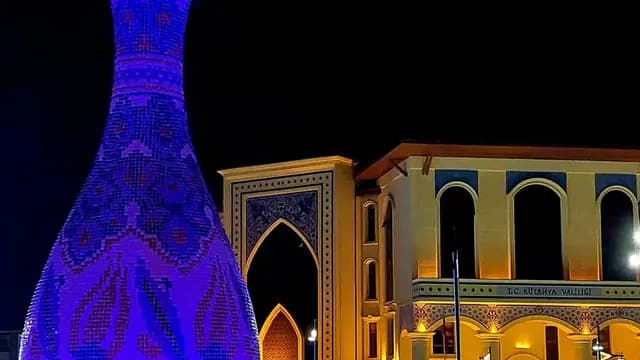
Kütahya Vase Monument
A giant vase on Zafer Meydanı in front of the governor's office, symbolizing the city's tile tradition.
Macellum of Aizanoi (the 'First Stock Exchange')
A round market building with a copy of Diocletian's maximum price edict on its walls; popularly 'the world's first stock exchange'.
Martyr Standard-Bearer Mehmetçik Monument
A monument on Zafertepe erected in memory of a soldier who did not let go of his standard during the Great Offensive.
Penkalas Bridge
A 2nd-century Roman bridge, still in use, crossing the Kocaçay near the Temple of Zeus.
Tavşanlı Mound
Tavşanlı, Kütahya
A large western Anatolian mound that looks heart-shaped from the air, bearing traces of about 8,000 years of settlement.
Temple of Zeus at Aizanoi
One of the best-preserved Roman temples in Anatolia; an Ionic temple with a vaulted underground chamber beneath it.
Zafertepe Victory Monument
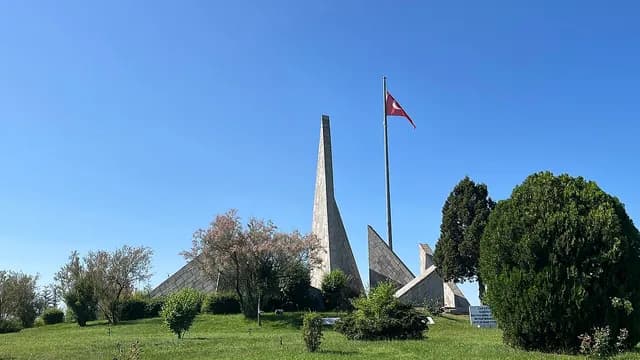
An abstract victory monument on the 1,181-meter hill from which Atatürk directed the Battle of the Commander-in-Chief.
Aigai Ancient City
Yunusemre, Manisa
The best-preserved ancient city of the Aeolis region, built at the top of Gün Dağı in the Yunt Mountains.
Apollonis Ancient City
Akhisar, Manisa
A Hellenistic city bearing the name of a Pergamene queen, built on the Konurca Kalesi hill 14 km west of Akhisar.
Atatürk and National Sovereignty Monument
Şehzadeler, Manisa
An Atatürk monument by sculptor Tankut Öktem, unveiled in 1985 on Manisa's Cumhuriyet Meydanı.
Bin Tepe Lydian Tumuli
Salihli, Manisa
A necropolis on the plain between the Gediz and Lake Marmara, made up of more than a hundred tumuli of Lydian kings and nobles.
Gavurtepe Mound
Alaşehir, Manisa
A steep-sided mound on the bank of the Sarıkız Çayı southwest of Alaşehir, commanding the Gediz plain.
Gergitha Ancient Settlement
Soma, Manisa
An ancient city near the sources of the Bakırçay, founded by a people settled there by King Attalus I of Pergamon.
Kaymakçı Mound
Gölmarmara, Manisa
The largest known Bronze Age settlement in the Gediz valley, overlooking Lake Marmara.
Kurşunlu Han
A two-story Ottoman han with 74 rooms, built in 1488 as part of the Hatuniye Complex.
Kuva-yi Milliye and Republic Monument
A monument at Kayapınar, at the southern entrance to Manisa, commemorating the militia forces of the War of Independence and the Republic.
Manisa Castle
Castle remains rising above the historic city center on the northern slope of Spil Dağı.
Manisa Palace and Fatih Tower
The Fatih Tower, the only surviving part of the palace where Ottoman princes served as provincial governors.
Mysian Stratonikeia
Kırkağaç, Manisa
An ancient city in Siledik village, founded in the Hellenistic period and also called Hadrianopolis in Roman times.
Philadelphia (Alaşehir)
An ancient city at the foot of the Bozdağlar on the trade route between Sardis and Kolossai; today beneath Alaşehir.
Sardis Ancient City
The capital of the Lydian Kingdom; an ancient city added to the UNESCO World Heritage List in 2025 together with Bin Tepe.
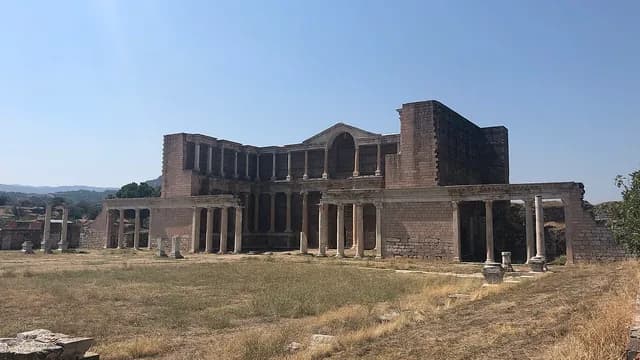
Sardis Bath-Gymnasium Complex
The large Roman-period bath and sports complex of Sardis, whose two-story facade has been re-erected.
Sidas (Saittai) Ancient City
Demirci, Manisa
An ancient city of the Lydia region near İcikler, with stadium, tomb and temple remains.
Taş Suret (Cybele Relief)
A monumental rock relief carved into the rock at Akpınar, depicting a Hittite goddess.
Temple of Artemis at Sardis
A Hellenistic temple in the Paktolos valley at the foot of the acropolis, known for its standing giant Ionic columns.
Ters Tepe Mound (Ters Tepe Höyüğü)
Selendi, Manisa
A settlement 1.5 km west-southwest of Selendi spanning the Chalcolithic to the Roman period; at 18 hectares, the largest mound in Manisa.
Thyateira (Tepe Mezarı Archaeological Site)
The ancient city lying beneath Akhisar; the center of one of the seven churches of early Christianity mentioned in the Book of Revelation.
Tumulus of Alyattes
The largest burial mound of Bin Tepe, belonging to the Lydian King Alyattes, 355 m in diameter and 69 m high.
Amos Ancient City
Marmaris, Muğla
A small Hellenistic-Roman settlement between Turunç and Kumlubük, with a theater and temple on a hill overlooking the sea.
Araxa Ancient City
Seydikemer, Muğla
A small Lycian city near the village of Ören, in the source area of the Eşen River.
Balbura Ancient City
A mountain city south of Altınyayla, a member of the Kibyra tetrapolis, with two theaters and an acropolis.
Baltalı Kapı (Gate of the Double Axe)
Milas, Muğla
The northern entrance of ancient Mylasa; a Roman gate known for the double-headed axe relief on its keystone.
Bargylia Ancient City
An ancient harbor city between Iasos and Myndos, founded on the shore of the Gulf of Güllük near the village of Boğaziçi.
Beçin Castle and Ancient City
A castle and medieval city on a rocky hill overlooking the Milas plain, once the capital of the Menteşe Beylik.
Bodrum Ancient Theater
Bodrum, Muğla
A 4th-century BC theater set into the Göktepe slope, overlooking Bodrum Bay and the castle.
Bodrum Castle
A castle of the Knights of Rhodes, home to the Museum of Underwater Archaeology.
Euromos Ancient City and Temple of Zeus
A Temple of Zeus with most of its columns standing among olive groves beside the Milas-Söke road.
Fethiye Castle (Castle of the Knights)
Fethiye, Muğla
The remains of a medieval castle on the hill above Fethiye, associated with the Knights of Rhodes.
Gümüşlük and Myndos Ancient City
Ancient Myndos, whose remains stretch toward the shore and Tavşan Adası, and the fishing village of Gümüşlük at the western tip of the Bodrum Peninsula.
Hafsa Sultan Caravanserai
A small 16th-century caravanserai at the foot of Marmaris Castle, now used as a bazaar.
Hekatomnos Mausoleum
The monumental tomb of the Carian satrap Hecatomnus, discovered in 2010 and regarded as a forerunner of the Mausoleum at Halicarnassus.
Herakleia (Latmos) Ancient City
An ancient city and the village of Kapıkırı on the eastern shore of Lake Bafa, set among the granite rocks of the Beşparmak Mountains.
Hyllarima Ancient City
Kavaklıdere, Muğla
An inland Carian city near the village of Derebağ (Mesevle), known for its Carian inscriptions.
Iasos Ancient City
An ancient harbor city on a peninsula in the Gulf of Güllük, right beside the fishing village of Kıyıkışlacık.
Idyma Ancient City
Ula, Muğla
A Carian city at the eastern end of the Gulf of Gökova, with temple-fronted tombs carved into the cliff above the village of Gökova.
Kadyanda Ancient City
A Lycian city on a pine-forested hill above Üzümlü, with a stadium and a bath.
Kalynda Ancient City
Dalaman, Muğla
An ancient city founded on the Caria–Lycia border, in the hills overlooking the Dalaman River valley.
Kaunos Rock Tombs
Köyceğiz, Muğla
Tombs with temple facades carved into the rock on the banks of the Dalyan River.
Kayaköy
An abandoned historic village with stone houses lined up along the hillside.
Kemer Roman Bridge
A surviving section of a Roman-period arched bridge at the edge of the Eşen River's wide gravel bed.
Keramos Ancient City (Ören)
The ancient Carian city that gave its name to the Gulf of Gökova; its remains are scattered among the houses of Ören.
Knidos Ancient City
Datça, Muğla
An ancient Carian city with two harbors at the tip of the Datça Peninsula.
Letoon (UNESCO)
The sacred center of the Lycian League; with its temples of Leto, Apollo and Artemis, a UNESCO World Heritage Site together with Xanthos.
Loryma Ancient City
Hellenistic fortress remains at the southern tip of the Bozburun Peninsula, overlooking Bozukkale bay.
Lydae Ancient City
A Roman-period settlement on the Kapıdağ Peninsula, with a mausoleum and cisterns on a deserted hill overlooking the Gulf of Fethiye.
Marmaris Castle and Museum
A harbor castle rebuilt by Süleyman the Magnificent during the Rhodes campaign, now used as a museum.
Mausoleum at Halicarnassus (Mausoleion)
The remains and open-air exhibition of the monumental tomb of Mausolus, satrap of Caria, counted among the Seven Wonders of the ancient world.
Myndos Gate
The western entrance of the walls of ancient Halicarnassus; a monumental gate surviving with its towers and the moat in front of it.
Pedasa Ancient City
A Carian settlement associated with the Leleges, founded on hills within pine forest near Konacık.
Pisye Ancient City
Menteşe, Muğla
A small Carian settlement near Yeşilyurt (Pissiköy), with an acropolis hill and wall remains.
Pınara Ancient City
A large Lycian city at the foot of a huge rock mass carved with hundreds of rock tombs.
Pydnai Fortress
A Hellenistic-period fortress at the western end of Patara beach, built to protect the road to Xanthos.
Sanctuary of Apollo at Emecik
The excavated remains of an Archaic-period sanctuary of Apollo near the village of Emecik.
Sanctuary of Hecate at Lagina
Yatağan, Muğla
The site of one of Anatolia's most important temples, dedicated to Hecate and linked to Stratonikeia by a sacred road.
Sanctuary of Labraunda
A Carian sanctuary built on terraces in the mountains above Milas, dedicated to Zeus Labraundos.
Sanctuary of Sinuri
A sanctuary on Tarla Tepe near Çamlıbelen, dedicated to the local god Sinuri and used for more than a thousand years.
Sidyma Ancient City
A small Lycian city whose sarcophagi and rock tombs are mixed in among the houses of Dodurga village.
Stratonikeia
A city bearing the traces of uninterrupted life from antiquity to the Ottoman period.
Telmessos Ancient Theater
A restored Roman theater from ancient Telmessos, right across from Fethiye harbor.
Theangela Ancient City
An ancient Carian city near Etrim, whose sturdy walls spread along the mountain ridge.
Tlos Ancient City
One of the oldest cities of Lycia, with a rocky acropolis facing the Akdağlar, rock tombs and a stadium.
Tomb of Amyntas (Amintas Kaya Mezarı)
A 4th-century BC Lycian tomb carved into the cliff above Fethiye, imitating an Ionic temple facade.
Akmonia Ancient City
Banaz, Uşak
A Phrygian city in Banaz's Ahat village, mentioned by Cicero, on the Dorylaion-Philadelphia road.
Atatürk and Liberation Monument
Merkez, Uşak
A large figurative monument on 15 Temmuz Şehitler Meydanı telling of Uşak's liberation in the War of Independence.
Blaundos Ancient City
Ulubey, Uşak
A Hellenistic-Roman city built on a canyon-ringed hill, founded in the time of the Macedonians.
Çeçeli Kara Murat Martyrs' Memorial
A memorial to the shepherd Kara Murat, who in 1922 deliberately showed a retreating Greek unit the wrong way.
Clandras Bridge
Karahallı, Uşak
A single-arched Roman-period aqueduct-bridge on the Banaz Çayı, at the head of the channel that carried water to Pepuza.
Göğem Victory Monument
A victory column marking the place where the Greek Commander-in-Chief Trikoupis was taken prisoner on September 2, 1922.
Hacı Gedik Han
A two-story stone han with shops on its ground floor, commissioned in 1893 at the Halıpazarı locality.
Pepuza Ancient City
A Phrygian city that was the center of the early Christian movement known as Montanism in the 2nd-6th centuries.
Sebaste Ancient City (Selçikler)
Sivaslı, Uşak
The remains at Selçikler of a city founded in the time of Augustus, which became the region's bishopric in the 6th century.
Alçak Köprü (Low Bridge)
Merkez, Amasya
A four-arched stone bridge rising on Roman-era piers, linking the castle side to the south bank.
Amasya King Rock Tombs
Monumental rock tombs of the Pontic kings carved into the slope of Mount Harşena; the symbol of Amasya and on the UNESCO World Heritage Tentative List.
Amasya Taşhan
A two-story Ottoman city han with a courtyard, built in 1699 by Mutasarrıf Rahtuvan Hacı Mehmet Paşa.
Aynalı Mağara Rock Tomb
A Hellenistic rock tomb with a polished facade, carved into the rock northeast of the city center; traces of Byzantine-era wall paintings survive inside.
Ezine Han
A Seljuk han in Ezinepazar village, built by Mahperi Hatun and restored and opened to visitors by the General Directorate of Foundations.
Ferhat Water Channel
A Hellenistic–Roman water channel at the foot of Mount Ferhat, cut into the rock and tunneled through it, and the subject of the legend of Ferhat and Şirin.
Harşena Castle (Amasya Castle)
A castle on the summit of Mount Harşena, repaired and used from the Pontic period to the Ottomans; with its cisterns and rock-cut water tunnel, it dominates the city.
Ardanuç (Gevhernik) Castle
Ardanuç, Artvin
A castle-town built on top of a huge rock mass in Adakale, the political center of the Klarjeti region in the Middle Ages; known in Turkish sources as Gevhernik Castle.
Artvin Atatürk Statue (Atatepe)
Merkez, Artvin
A 22-meter giant statue on Atatepe, south of the city, depicting Atatürk walking over rocks at Dumlupınar, with a viewing area.
Artvin Castle (Livane Castle)
A small medieval castle on a sheer rock overlooking the Çoruh River at the entrance to the city, popularly known as Livane Castle.
Çifte Köprü (Kamilet Twin Bridges)
Arhavi, Artvin
Two historic stone arch bridges set at right angles to each other at the confluence of the Kamilet and Durğuna streams, at the entrance to the Kamilet Valley.
Peterek Castle
Yusufeli, Artvin
A medieval castle built on bedrock on a hill overlooking the Çoruh valley in Çevreli (Peterek) village, which served as the center of a sanjak of the same name in the Ottoman period.
Satlel (Şavşat) Castle
Şavşat, Artvin
A 9th-century castle on a high outcrop of bedrock in the Söğütlü neighborhood at the entrance to Şavşat, with towers, chapel remains and a rock-cut cistern.
Amasra Castle
Amasra, Bartın
Amasra Castle, in two parts enclosing Boztepe Island and the Zindan neighborhood, spanning the Roman, Genoese and Ottoman eras.
Kuşkayası Road Monument
A rock-cut monument with reliefs of an eagle and a figure, commemorating road building in the reign of the Roman Emperor Claudius (AD 41–54).
Tekkeönü Castle (Kromna)
Kurucaşile, Bartın
Castle remains, rock wells and a tunnel said to extend to the sea at Tekkeönü in Kurucaşile, the center of the ancient city of Kromna.
Aydıntepe Underground City
Aydıntepe, Bayburt
An underground settlement beneath the Aydıntepe district center, consisting of about 1 km of galleries, rooms and ventilation shafts carved into volcanic tuff.
Bayburt Castle
Merkez, Bayburt
A large medieval castle on a hill dominating the city, overlooking the Çoruh Valley, repaired many times from the Byzantine to the Saltukid and Ottoman periods.
Büyüktepe Höyük
Demirözü, Bayburt
A mound near the village of Çiftetaş, consisting of two hills joined by a neck, with layers from the 4th millennium BC to the Middle Ages.
Keçi Kalesi (Goat Castle)
Gerede, Bolu
Wall remains on a plateau on Arkut Dağı just north of Gerede, used in Late Antiquity and the Middle Ages.
Seben Rock Houses (Solaklar)
Seben, Bolu
Multi-story rock houses carved into soft rock beside the village of Solaklar, connected to one another by shafts.
Yukarı Taşhan (Upper Stone Han)
Merkez, Bolu
A stone han commissioned in 1804 by Hacı Abdullah Ağa, with a two-story arcaded courtyard, today home to booksellers and tradesmen's shops.
Alacahöyük Archaeological Site and Museum
Alaca, Çorum
A mound where four layers of civilization have been uncovered, famous for its Sphinx Gate and Early Bronze Age royal tombs; an excavation museum stands at its entrance.
Büyükkale (Great Citadel)
Boğazkale, Çorum
Hattusa's walled royal citadel, where the palace of the Hittite great kings stood and where thousands of cuneiform tablets were found.
Çorum Castle
Merkez, Çorum
A square-plan Seljuk castle on a low hill south of the city center, dominating the plain; houses and a small mosque still stand inside it.
Hattusa Ancient City
The capital of the Hittite Empire; a UNESCO World Heritage Site since 1986 with its walls, monumental gates, temples and royal citadel.
İskilip Castle and Rock Tombs
İskilip, Çorum
A castle on top of a natural rock mass about 100 meters high in central İskilip, and Roman-period rock tombs with lion and Eros reliefs on its southern foot.
Kandiber Castle
Osmancık, Çorum
A castle built on a natural rock on the north bank of the Kızılırmak at Osmancık, dominating the town and the Koyunbaba Bridge.
Kapılıkaya Rock Tomb
Laçin, Çorum
A 2nd-century BC Hellenistic rock tomb carved into a steep rock mass between Laçin and Kırkdilim, with the inscription 'Ikezios' on its door.
King's Gate (Kral Kapısı)
A monumental gate in the east of Hattusa's walls; known for the copy of the warrior god relief on its inner face.
Koyunbaba (Bayezid II) Bridge
A fifteen-span stone bridge about 250 meters long over the Kızılırmak at Osmancık, commissioned by Bayezid II between 1484 and 1489.
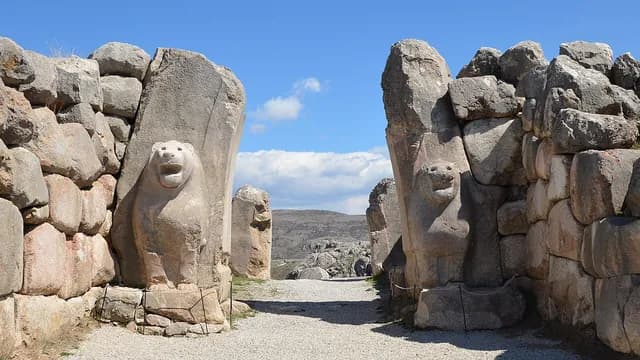
Lion Gate (Aslanlı Kapı)
A monumental city gate in the southwest of Hattusa's walls, flanked by two towers, its outer face guarded by two lion statues.
Resuloğlu Höyük and Necropolis
Uğurludağ, Çorum
An Early Bronze Age mound and cemetery west of Uğurludağ, where more than 200 graves dated to before the Hittites (mid-3rd millennium BC) have been excavated.
Shapinuwa (Şapinuva)
Ortaköy, Çorum
A Hittite administrative and religious center at Ortaköy, discovered in 1989 through tablets found by a farmer, where thousands of cuneiform tablets have been unearthed.
Veli Paşa Hanı
A two-story wooden city han from the late 19th century; restored with its three-story kiosk known as the 'Anadolu Oteli' and reopened in 2022.
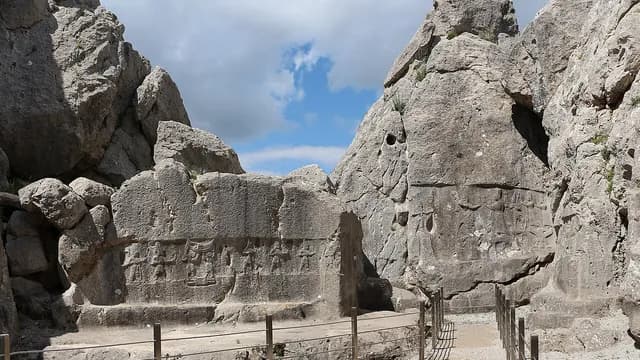
Yazılıkaya Open-Air Sanctuary
A sacred site 2 km northeast of Hattusa, where reliefs of Hittite gods and goddesses are carved on the walls of natural rock galleries.
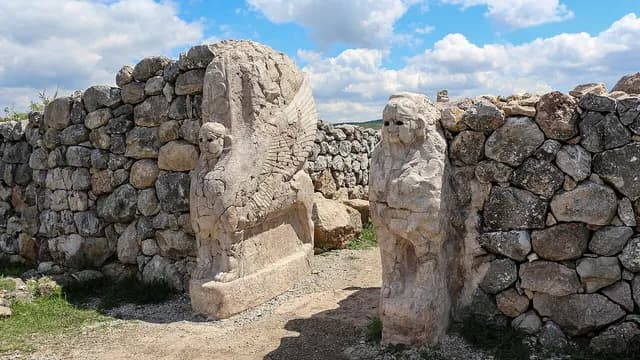
Yerkapı and the Sphinx Gate
The artificial embankment at the highest point of Hattusa; one of the city's most impressive structures with the stone tunnel (postern) beneath it and the sphinx gate above.
Akçakoca Genoese Castle
Akçakoca, Düzce
A medieval castle on the UNESCO World Heritage Tentative List, rising on the cliff between two coves west of Akçakoca.
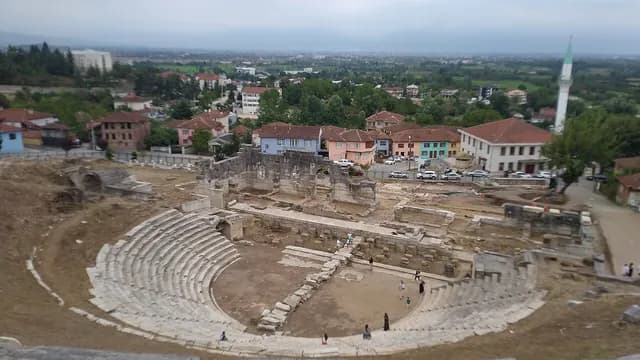
Prusias ad Hypium Ancient Theater
Merkez, Düzce
The ancient theater, popularly called 'Kırk Basamaklar', of the Bithynian city of Prusias ad Hypium, known as 'the Ephesus of the Western Black Sea'.
Andoz Castle
Espiye, Giresun
A registered medieval castle built on a steep rock west of Espiye, dominating the mouth of the Yağlıdere valley.
Bedrama Castle
Tirebolu, Giresun
The remains of a medieval castle on natural rocks dominating the Harşit Valley, 8 km south of Tirebolu.
Bendehor (Mendehorya) Castle
Piraziz, Giresun
Small castle remains in Piraziz, thought to have been built before the Turks came to the region.
Çakrak Churches and Arch Bridges
Alucra, Giresun
A historic village fabric in the village of Çakrak northwest of Alucra, where the remains of two churches and three stone arch bridges stand together.
Eynesil Castle
Eynesil, Giresun
A registered castle on a rocky peninsula 2 km east of Eynesil, divided in two by a wall through the middle.
Giresun Castle
Merkez, Giresun
A castle park on the hilltop of the peninsula in the middle of the city, with walls from the Pontic period and the Tomb of Topal Osman Ağa; the best place to view the city.
Şebinkarahisar Castle
Şebinkarahisar, Giresun
A historic castle above Şebinkarahisar, consisting of inner and outer castles on a basalt rock, with an octagonal tower and rock cisterns.
Şebinkarahisar Taşhanlar (Stone Hans)
The remains of masonry bedesten buildings in the Şebinkarahisar bazaar, commissioned in the 17th century by Taban Ahmet Ağa.
Tirebolu Castle (Sen Jan Castle)
Sen Jan Castle on a natural rock extending into the sea in central Tirebolu, with buttressed walls and artillery towers.
Canca Castle
Merkez, Gümüşhane
An old castle on a rocky hill, considered the first settlement of Gümüşhane, which gained importance through silver mining.
Kov Castle
A medieval castle built on top of a steep rock mass rising about 130 meters above its surroundings, in the village of Esenyurt.
Santa Ruins
The stone house and church remains of an old Greek mining settlement with seven neighborhoods spread over the slopes of the Yanbolu Valley in the village of Dumanlı.
Satala Ancient City
Kelkit, Gümüşhane
The remains of a legionary camp in the village of Sadak, home to Rome's Fifteenth Apollinaris legion, and of the ancient city that grew around it.
Cinci Hanı
Safranbolu, Karabük
A grand han commissioned in the 1640s in the center of the Safranbolu bazaar by Cinci Hoca, Kazasker of Rumelia, used today as a hotel.
Hadrianopolis Ancient City
Eskipazar, Karabük
A Roman–Byzantine city of Paphlagonia near Eskipazar, with mosaic churches, baths and rock tombs, where excavation is ongoing.
İncekaya Aqueduct
A historic aqueduct over the Tokatlı Canyon, 116 meters long and reaching a height of 60 meters.
Ağlı Castle
Ağlı, Kastamonu
Castle remains considered the most important building surviving from Ağlı's period under Byzantine rule.
Araç Castle
Araç, Kastamonu
A small district castle on a rock overlooking the Araç Çayı, founded in the Byzantine period and repaired in the Ottoman era.
Gökçeağaç Han
Hanönü, Kastamonu
An old caravanserai building, claimed to be of church origin, which gave the district its name.
Historic Stone Bridge (Taşköprü)
Taşköprü, Kastamonu
A seven-span, 68-meter historic stone bridge over the Gökırmak, which gave the district its name.
Kalekapı Rock Tomb
A monumental Paphlagonian rock tomb carved into a steep rock mass near the village of Donalar in Taşköprü.
Kastamonu Castle
Merkez, Kastamonu
A medieval castle on the rocky hill southwest of the city, thought to take its name from the Byzantine-period 'Castle of the Komnenoi'.
Pompeiopolis Ancient City
A Paphlagonian city founded in the 1st century BC by the Roman general Pompey, with excavations ongoing on Zımbıllı Tepe opposite Taşköprü.
Bolaman Castle and Hazinedaroğlu Mansion
Fatsa, Ordu
The castle on a small peninsula extending into the sea at Bolaman and the 18th-century wooden Hazinedaroğlu Mansion built on top of the inner castle.
Gençağa Castle
İkizce, Ordu
A castle on a steep rock mass in İkizce, accepted as having been built in the 13th century by the Hacıemiroğulları, with views as far as the Black Sea.
Kurul Castle
Altınordu, Ordu
A castle on a pointed rock at Bayadı, where a Hellenistic statue of Cybele was found, considered one of the first archaeological excavation sites of the Black Sea region.
Tikenlice Rock Tombs
Gürgentepe, Ordu
A group of monumental tombs carved into the rock in the Tikenlice neighborhood of Gürgentepe.
Tozkoparan Rock Tomb
Ünye, Ordu
A rock tomb about 5 km east of Ünye, with a large round-arched entrance and two nested chambers.
Ünye Castle and Rock Tomb
A castle about 2,500 years old on the Ünye–Niksar road, with a rock tomb with a temple facade and eagle reliefs at its entrance.
Buzlupınar Bridge
Çayeli, Rize
A historic wooden bridge about 40 m long, made of chestnut wood, over the Senoz Deresi.
Çağlayan Bridge
Fındıklı, Rize
A historic single-span bridge in the Çağlayan Valley of Fındıklı, crossing the Çağlayan Deresi with a cut-stone arch.
Ciha Castle
Pazar, Rize
A circular-plan medieval watch castle rising on a hill overlooking the Hemşin Deresi valley, in the village of Yücehisar in Pazar.
Dörtgözlü Bridge (Koca Köprü)
Rize's longest historic stone bridge, about 69 m long, crossing the Hemşin Deresi with four arches on the Pazar–Hemşin road.
Kale-i Bala (Varoş Kale)
Çamlıhemşin, Rize
A medieval castle on a steep rock above the Fırtına Valley, dominating the point giving passage from the Kaçkars to Anatolia.
Rize Castle
Merkez, Rize
A historic castle rising on the hill southwest of the city, whose inner castle is linked to the time of the Byzantine Emperor Justinian I.
Şenyuva Bridge
A single-span stone arch bridge built in 1696 over the Fırtına Deresi, about 40 m long and 20 m high.
Zilkale
A restored medieval castle in the Fırtına Valley, built on a steep rock about 100 m above the streambed.
Akalan Castle
Atakum, Samsun
An ancient settlement castle on the plateau beside the Karadere in Atakum, surrounded by walls about 1 km long.
Asarkale, Rock Tombs and Postern
Bafra, Samsun
A castle on a huge rock mass overlooking the dam lake on the Kızılırmak, with a secret passage (postern) carved into the rock and rock tombs.
Çetinkaya Bridge
A 250-meter reinforced-concrete arched bridge built in 1937 in Bafra, associated with the wedding tradition of brides walking across it.
Garpu Castle (Amazon Castle)
Salıpazarı, Samsun
An open-air temple popularly called Amazon Castle, on a rocky hill overlooking the Çarşamba Plain, known for its rock-cut stairs and Phrygian-type rock altar.
Historic Çarşamba Bridge
Çarşamba, Samsun
A historic bridge over the Yeşilırmak in Çarşamba, opened in 1931, with 10 spans and 270 meters long; today open to pedestrians only.
İkiztepe Mound
A mound near Bafra that has yielded more than ten thousand artifacts from the pre-Hittite Chalcolithic and Early Bronze Age.
İlkadım Monument
İlkadım, Samsun
A monument by Hakkı Atamulu marking the site of the pier where Atatürk set foot in Samsun on 19 May 1919.
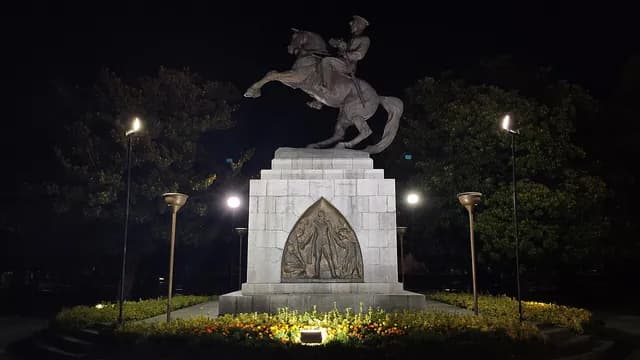
Onur Monument (Monument of Honor)
A bronze monument unveiled in 1932, showing Atatürk on a rearing horse; it was made with donations from the people of Samsun.
Boyabat Castle
Boyabat, Sinop
A castle rising on a steep rocky hill in the Gökırmak Valley, used from the Paphlagonians to the Ottomans.
Durağan Han
Durağan, Sinop
A historic han on the old caravan route that gave its name to Durağan, founded where the Kızılırmak and the Gökırmak meet.
Paşa Bastions (Paşa Tabyaları)
Merkez, Sinop
A crescent-shaped coastal bastion built on the southeast of the peninsula during the Crimean War to protect Sinop against attacks from the sea.
Salar Rock Tomb
A monumental rock tomb carved into the rock in the village of Salar in Boyabat, dated to the Paphlagonian period, and the ecotourism route around it.
Sinop Fortress
The historic wall system enclosing the isthmus of the Sinop Peninsula, stretching between the inner and outer harbors and still defining the city's silhouette today.
Ancient City of Sebastopolis
Sulusaray, Tokat
The ancient city of Sebastopolis lying beneath Sulusaray, where a Roman bath and a Byzantine church have been brought to light by excavations.
Artova Underground Settlement (Boyunpınar)
Artova, Tokat
An Early Christian underground settlement carved into the bedrock north of the village of Boyunpınar, with three levels and three corridors.
Hıdırlık Bridge
Merkez, Tokat
A Seljuk bridge over the Yeşilırmak dated 1250, with five arches and 151 meters long; today open to pedestrians.
Leylekli (Yılanlı) Bridge
Niksar, Tokat
A single-arched historic bridge over the Çanakçı Deresi, known for the relief on its keystone of a stork holding a snake in its beak.
Mahperi Hatun Caravanserai
Pazar, Tokat
A Seljuk caravanserai with a muqarnas portal in Pazar, commissioned by Mahperi Hatun in 1238.
Niksar Castle
The castle of ancient Kabeira; according to Ministry sources the second-largest castle in Türkiye, with remains of a madrasa, hamams and a dungeon inside.
Taşhan (Voyvoda Hanı)
One of Anatolia's largest city hans, built in 1626–1632; today lively with handicraft and yazma shops.
Tokat Castle
A castle on the steep rock in the middle of the city, used from the Roman to the Ottoman period; known for its rock-cut secret passage and dungeon stories.
Turhal Castle
Turhal, Tokat
A castle overlooking Turhal on a steep rock about 180 meters above the plain, known for its passages descending into the mountain.
Zile Castle
Zile, Tokat
A Roman castle rising on the mound in the middle of Zile; associated with Caesar's words 'Veni, vidi, vici'.
Akçakale Castle
Akçaabat, Trabzon
A medieval castle on a terrace overlooking the sea, thought to have been built in the time of Alexios II to protect the west of Trabzon.
Canayer Castle
Araklı, Trabzon
Roman-period castle remains in the Buzluca (formerly Canayer) neighborhood west of Araklı, associated with the ancient settlement of Hyssus/Sürmene.
Hapsiyaş Bridge (Kiremitli Köprü)
Of, Trabzon
A wooden bridge built in 1935 over the Solaklı Deresi, resting on stone piers and notable for its tile-covered roof.
Kalepark (Güzelhisar Castle)
Ortahisar, Trabzon
A park laid out on a rocky hill overlooking the harbor, on the site of Leonkastron, the medieval castle built by Genoese merchants.
Kaşıkçı Bridge
Arsin, Trabzon
A single-arched historic bridge of cut and rubble stone over the Yanbolu Deresi in the interior of Arsin.
Tabakhane Bridge
A two-tiered, six-arched historic stone bridge crossing the Tabakhane Deresi valley east of Ortahisar.
Trabzon Castle
Historic city walls on the rock mass between the Tabakhane and Zağnos valleys, consisting of the Yukarı, Orta and Aşağı Hisar.
Zağnos Bridge
A single-span historic stone bridge connecting Ortahisar to the Atapark side, repaired by Zağanos Paşa in the 15th century.
Ancient City of Tieion (Filyos)
Çaycuma, Zonguldak
The ancient city of Tieion, founded by the Milesians where the Filyos Çayı flows into the Black Sea, with its acropolis, theater and harbor under ongoing excavation.
Ereğli Castle
Ereğli, Zonguldak
Castle remains on the hill overlooking the harbor and city center in Ereğli, site of ancient Herakleia Pontike.
Uzunmehmet Miner Monument
Merkez, Zonguldak
A monument commemorating Uzun Mehmet, who discovered hard coal in 1829, and Zonguldak's mining past.
Acemhöyük
Merkez, Aksaray
A large mound in Yeşilova, one of the important centers of the Assyrian Trade Colonies Period, where two palaces have been uncovered.
Ağzıkara Han
A Seljuk caravanserai with rich stone decoration on the Aksaray–Nevşehir road; its covered section was completed in 1231 and its courtyard in 1240.
Alay Han
One of the earliest Seljuk caravanserais in Anatolia, on the Aksaray–Nevşehir road, dated to the reign of Kılıç Arslan II.
Aşıklı Höyük
Gülağaç, Aksaray
An Aceramic Neolithic village on the banks of the Melendiz, dated to 8200–7500 BC, documenting the transition to settled life; an experimental archaeology site.
Ersele Underground City
Ortaköy, Aksaray
A large underground settlement in Ozancık village (Ortaköy), with storage rooms, water channels and wine- and cheese-making spaces carved into the tuff.
Güzelyurt Underground City
Güzelyurt, Aksaray
An underground city in central Güzelyurt, entered through the Seljuk-era 'Develik' structure, with three of its seven levels cleared and open to visitors.
Öresin Han
A small Seljuk han on the Aksaray–Nevşehir road, also called 'Tepesi Delik Han' (Han with a Hole in the Top) for its courtyardless plan and the light opening at its top.
Sultan Hanı Caravanserai
Sultanhanı, Aksaray
Built by Alâeddin Keykubad I in 1229, one of the largest Seljuk caravanserais in Anatolia, covering about 4,800 m².
Anıtkabir
Çankaya, Ankara
The mausoleum of Mustafa Kemal Atatürk; Turkey's most visited monument, on Anıttepe, with the Road of Lions, Ceremonial Plaza, Hall of Honor and museums.
Ankara Castle
Altındağ, Ankara
A historic castle on the volcanic hill above Ulus, whose inner and outer walls preserve the city's oldest settlement core.
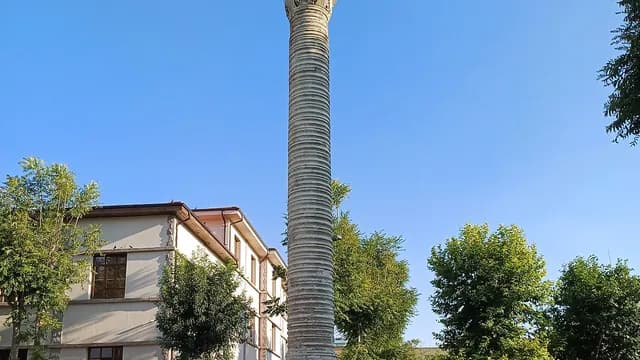
Column of Julian
A fluted column believed to have been erected to commemorate Roman emperor Julian's visit to Ankara in 362, popularly known as the Belkıs Minaresi.
Duatepe Monument and Martyrs' Memorial
Polatlı, Ankara
The monument and martyrs' memorial on the hill on the last defensive line of the Battle of Sakarya, retaken in the offensive of 10 September 1921.
Gavurkale Hittite Rock Monument
Haymana, Ankara
A small but important cult site near Haymana, known for its Hittite deity reliefs carved into the rock and its wall remains.
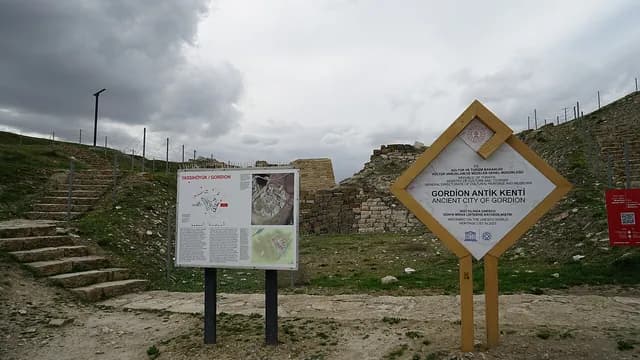
Gordion Ancient City
The capital of Phrygia; the ancient settlement known as the city of King Midas, inscribed on the UNESCO World Heritage List in 2023.
Güvenpark and Güven Monument
A Republican-era monument in Güvenpark, Kızılay, begun by Anton Hanak and completed by Josef Thorak in 1935.
İnönü Caves
Güdül, Ankara
An archaeological site in the Kirmir Stream valley consisting of multi-level caves, church-like spaces and stairs carved into volcanic rock.
Kalecik Castle
Kalecik, Ankara
A historic castle rising above Kalecik district on a hill overlooking the Kızılırmak valley.
Kız Köprüsü (Karaboğaz Bridge)
Ayaş, Ankara
A 1930s bridge on the Ankara–Beypazarı road, in whose construction Sabiha Rıfat (Gürayman) Hanım, one of Turkey's first women civil engineers, took part.
Mehmetçik Monument
A 22-meter Mehmetçik statue erected in 2008 on Kartaltepe west of Polatlı in memory of the martyrs of the Battle of Sakarya.
Roman Bath Open-Air Museum
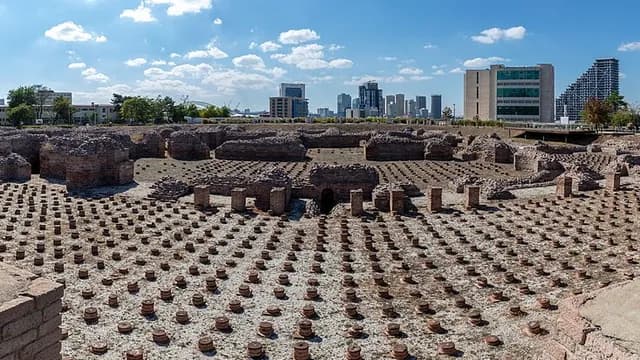
The remains of a large city bath built in the early 3rd century under the Roman emperor Caracalla, laid out as an open-air museum.
Suluhan
A historic Ankara han built in the early 16th century, with two courtyards and a small masjid in the middle.
Temple of Augustus
The remains of a late-1st-century BC temple whose walls bear the famous inscription recounting the deeds of the Roman emperor Augustus.
Zafer Anıtı (Victory Monument, Ulus)
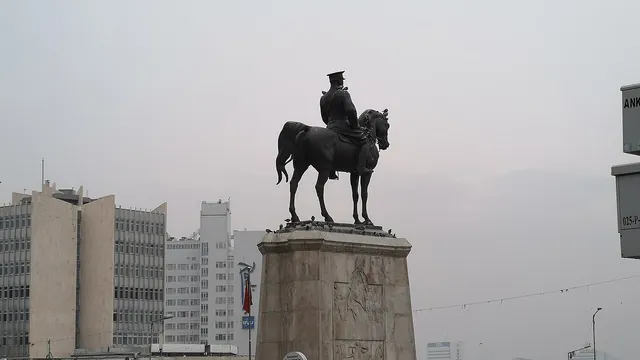
A monument on Ulus Square depicting Atatürk on horseback, unveiled in 1927 and a symbol of Republican Ankara.
Bayramören Bridge
Bayramören, Çankırı
A two-span, tile-roofed footbridge over the Melan Stream, built with wooden planks on stone piers.
Beşdut Rock Tombs
Merkez, Çankırı
Two monumental rock tombs, one with columns, carved into the rocks on either side of the stream in Beşdut village.
Çankırı Castle and Karatekin Tomb
The city's viewing terrace on the hill to the north, with wall remains and the tomb of Emir Karatekin, who conquered Çankırı.
Çerkeş Kemer Bridge
Çerkeş, Çankırı
A three-arched Ottoman bridge over the Çerkeş Stream (Ulusu), thought to have been built under Suleiman the Magnificent and repaired by Murad IV.
Hüyük Underground City
Orta, Çankırı
A multi-level underground settlement in Hüyük village, Orta, dated to the 3rd–5th centuries AD, with a small church, monks' cells and a cistern.
İndağı Rock Tombs
Ilgaz, Çankırı
Caves, rock tombs and the remains of a rock temple carved into rocky slopes overlooking the Devrez Stream southeast of Ilgaz.
Sakaeli Rock Tombs and Gelin Kayası
Roman–Byzantine rock tombs carved into a hillside in Sakaeli village, Orta, and the fairy chimneys at the Gelin Kayası area.
Doğanlı Kale (Doğanlı Castle)
Seyitgazi, Eskişehir
A rock castle in the north of the Phrygian Valley, with rock-cut rooms and passages bearing traces of the Phrygian, Roman and Byzantine periods.
Gerdekkaya Rock Tomb
A Hellenistic-period monumental tomb carved into the rock near the village of Çukurca, with a facade with a pediment and two columns.
Han Underground City
Han, Eskişehir
Underground galleries in the Han district center, consisting of multi-level rooms, corridors and water channels carved into the rock.
Karacahisar Castle
Odunpazarı, Eskişehir
The remains of a Byzantine castle taken by Osman Bey in 1288, considered a turning point in the founding of the Ottoman Principality.
Küllüoba Mound (Höyük)
A key mound of Western Anatolian prehistory with a palace and walls, continuously settled from the Late Chalcolithic to the end of the Early Bronze Age.
Midas City and the Midas Monument (Yazılıkaya)
A Phrygian settlement consisting of the Midas Monument, a 17-meter Phrygian cult facade carved into the rock, and the acropolis, cisterns and rock steps.
Pessinus Ancient City
Sivrihisar, Eskişehir
A Phrygian and Roman city in the village of Ballıhisar, one of the most important centers of the cult of the Mother Goddess Cybele.
Ruins of Germia and the Church of the Archangel Michael
Günyüzü, Eskişehir
The ruined remains of the great basilica dedicated to the Archangel Michael at Germia, an Early Byzantine pilgrimage town, in the village of Gümüşkonak.
Şarhöyük (Dorylaion)
Tepebaşı, Eskişehir
Eskişehir's oldest settlement; the mound of the ancient city of Dorylaion, now within the city.
Ulus Monument
A monument at the İstasyon Junction carrying a statue of Atatürk with tiered reliefs stretching from the War of Independence to modern Türkiye.
Atlas Han
Ayrancı, Karaman
A relatively well-preserved Seljuk han right beside the railway at Hüyükburun, built with spolia stones.
Binbirkilise (Thousand and One Churches)
Merkez, Karaman
The remains of about fifty Byzantine churches spread around Madenşehri and Değle on the northern slopes of the Karadağ volcano.
Bıçakçı Bridge
A 14th-century stone bridge rising with a single large arch over the Göksu on the Bucakkışla–Ermenek road.
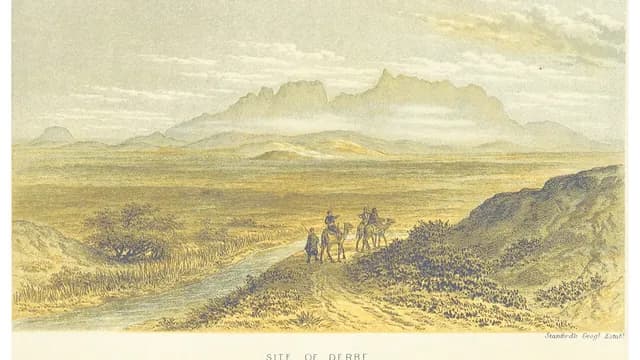
Derbe (Kerti Höyük)
Kerti Höyük, accepted as the site of the ancient city of Derbe, visited by Paul on his missionary journeys.
Karaman Castle
A Seljuk and Karamanid-period castle rising on the mound in the middle of the city, with its inner castle still standing; a wide view of the Karaman plain.
Köristan Archaeological Site and Rock Tombs
Sarıveliler, Karaman
Roman-period rock tombs within a cedar and fir forest near Göktepe, with pediments carved with Medusa and lion reliefs.
Köskerlik Rock Tombs (Sidamara Necropolis)
Rock tombs going back to the Hellenistic–Byzantine periods near the village of Ambar, where the famous Sidamara sarcophagus was found.
Fıraktın Rock Relief
Develi, Kayseri
A 13th-century BC rock relief east of Develi depicting the Hittite king Hattusili III and queen Puduhepa making offerings to the gods.
Hızır İlyas Pavilion (Köşk)
Kocasinan, Kayseri
One of the rare surviving examples of Anatolian Seljuk pavilions, built in 1241 on Hıdırellez Hill in Erkilet in the time of Gıyaseddin Keyhüsrev II.
Kara Mustafa Paşa Complex and Caravanserai
İncesu, Kayseri
A large Ottoman staging-post complex at İncesu consisting of a caravanserai, mosque, hamam and arasta, commissioned in 1660 by Merzifonlu Kara Mustafa Paşa.
Karakuyu Hittite Dam
Pınarbaşı, Kayseri
An earth-embankment dam from the 13th century BC near the village of Karakuyu in Pınarbaşı, known for its block stones inscribed in the name of the Hittite king Tudhaliya IV.
Karatay Han
Bünyan, Kayseri
A two-part caravanserai with a masjid and hamam on the Kayseri–Malatya road, commissioned by the Seljuk vizier Celâleddin Karatay.
Kayseri Castle
Melikgazi, Kayseri
A castle in the very center of the city, founded in the Roman period and repaired in the Byzantine, Seljuk and Ottoman periods, known for its walls of dark volcanic stone.
Kültepe (Kanesh-Karum) Archaeological Site
The mound and lower city of Kanesh-Karum, the Assyrian trading colony where 23,500 cuneiform tablets, Anatolia's first written documents, were found.
Lifos Dağı Archaeological Site
Hacılar, Kayseri
The remains of a mountain settlement of uncertain date, surrounded by a wall with 16 bastions, on the crater-shaped summit plain of Lifos Dağı northeast of Erciyes.
Safrantı Castle
Felahiye, Kayseri
The remains of an ancient castle near the town of Kayapınar in Felahiye, built on a 1902-meter pointed hill and known for its rock-cut cistern.
Şahruh Bridge
Sarıoğlan, Kayseri
A historic eight-arched bridge 144.5 meters long in the village of Karaözü in Sarıoğlan, commissioned by the Dulkadirid Şahruh Bey.
Soğanlı Archaeological Site
Yeşilhisar, Kayseri
An archaeological site at the southeastern tip of Cappadocia, known for its rock-cut Byzantine churches, wine rooms and cloth dolls in a valley that divides into two branches.
Sultan Hanı (Tuzhisar)
Türkiye's second-largest medieval caravanserai, commissioned in 1232–1237 by Alaeddin Keykubad I on the Kayseri–Sivas road.
Yazıkışla Temple Tomb
A Roman-period temple-shaped monumental tomb standing up to its cornice in the middle of fields in Felahiye, notable for its pilasters with Corinthian capitals.
Zamantı (Melikgazi) Castle
A 13-towered castle in the village of Melikgazi in Pınarbaşı, controlling the Zamantı and Elbistan roads, built by the Byzantines and strengthened in the Danishmendid and Seljuk periods.
Büklükale Archaeological Site
Karakeçili, Kırıkkale
A mound and archaeological site on the bank of the Kızılırmak, shown by excavations to have been an important city in the Hittite Imperial period.
Çeşnigir Bridge
A cut-stone bridge over the Kızılırmak dated to the 13th century and repaired in the Ottoman period, today open only to pedestrians.
Yahşihan Historic Iron Bridge
Yahşihan, Kırıkkale
A historic bridge over the Kızılırmak, built in the reign of Abdülhamid II and referred to as the first iron bridge in Anatolia.
Kaman Kalehöyük
Kaman, Kırşehir
A mound 280 meters in diameter east of Kaman, excavated by Japanese archaeologists since 1986, with layers stretching through the Bronze, Iron and Ottoman ages.
Kesikköprü
Merkez, Kırşehir
A 13-arched Seljuk bridge 220 meters long over the Kızılırmak, built in 1248 in the time of İzzeddin Keykavus II according to its inscription.
Kesikköprü Caravanserai (Cacabey Hanı)
A Seljuk caravanserai in the village of Kesikköprü, commissioned by Nureddin Caca, Emir of Kırşehir, notable for its portal built of two-colored stones.
Mucur Underground City
Mucur, Kırşehir
An underground city in Mucur dated to the Early Christian period, connected by galleries and tunnels, with ventilation shafts and rolling stones.
Akören Bridge
Akören, Konya
A four-span stone bridge in Orhaniye, built at the end of the 19th century.
Arısama Castle
Emirgazi, Konya
Castle remains dominating the region on the summit of Arısama Dağı north of Emirgazi, an area famous for its Hittite-period inscribed altars.
Belbaşı Han
A ruined Seljuk han on the Konya–Seydişehir caravan road, still standing together with the stone cistern beside it.
Beyşehir Taşköprü (Stone Bridge)
Beyşehir, Konya
A stone-arched regulator bridge built between 1908 and 1914 that releases the water of Lake Beyşehir to the Konya Plain; famous for its sunset views.
Boncuklu Höyük
Karatay, Konya
One of the world's oldest village settlements, dated to 8300–7800 BC and considered the forerunner of Çatalhöyük; open-air reconstructed houses.
Çatalhöyük Neolithic Town
Çumra, Konya
A Neolithic town where thousands of people lived between 7400 and 6000 BC; a UNESCO World Heritage Site with its wall paintings and houses entered from the roof.
Eflatunpınar Hittite Water Monument
A sacred water monument of the Hittite Imperial Age on the edge of the pool where spring water is collected, with reliefs of gods and winged suns.
Fasıllar Monument
An unfinished Hittite Storm God monument, about 8 meters tall and weighing 70 tons, lying on a slope near the village of Fasıllar.
Harunlar (Asar) Castle
Yunak, Konya
A two-part Byzantine castle with inner and outer walls south of the Harunlar neighborhood, surrounded by rock-cut houses.
Horozlu Han
Selçuklu, Konya
The Seljuk caravanserai closest to the city on the old Konya–Akşehir road; commissioned in the mid-13th century by Emir Esedüddin Ruzbe.
İvriz Rock Monument
Halkapınar, Konya
An 8th-century BC Late Hittite rock relief depicting King Warpalawas of Tuwana praying to the Storm God Tarhunza.
Kadınhanı (Raziye Sultan Hanı)
Kadınhanı, Konya
A Seljuk caravanserai commissioned by Raziye Hatun in 1223, which gave the Kadınhanı district its name; today an exhibition hall.
Kilistra Ancient City
Meram, Konya
An ancient settlement near Hatunsaray resembling Cappadocia, with rock-cut churches, chapels, cisterns and dwellings.
Kubadabad Palace
The summer palace of Alâeddin Keykubad I on the southwest shore of Lake Beyşehir; the only surviving palace remains of the Anatolian Seljuks.
Sazak Bridge
Taşkent, Konya
An Ottoman-period stone bridge 62 meters long with three round arches over the Balcılar Çayı, a tributary of the Göksu.
Zazadin Han
A monumental Seljuk caravanserai on the Konya–Aksaray road, completed in 1236 according to its inscription, built with spolia stones.
Zengibar Castle (Isaura)
Bozkır, Konya
The impressive remains of the walls and buildings of the ancient city of Isaura, on a 1,800-meter hill on Asar Dağı surrounded by cliffs on three sides.
Zengicek Castle
Altınekin, Konya
A 5th-century Byzantine castle rising on a rocky plateau of Bozdağ near Koçyaka (Zengicek).
Zıvarık Hanı
A restored caravanserai with a covered plan in central Altınekin, notable for the spolia stones in its portal.
Açıksaray Archaeological Site
Gülşehir, Nevşehir
An archaeological site 3 km south of Gülşehir, with residential complexes with monumental facades carved into tuff, rock churches and mushroom-shaped rocks.
Derinkuyu Underground City
Derinkuyu, Nevşehir
Türkiye's largest excavated underground city, descending to a depth of about 85 meters, thought to have sheltered thousands of people with their animals and provisions.
Gorgoli Hill
Ürgüp, Nevşehir
A hill 5 km south of Mustafapaşa, with the remains of the 19th-century Church of the Virgin Mary on its summit and rock-carved spaces and churches at its foot.
Kaymaklı Underground City
Merkez, Nevşehir
One of Cappadocia's most visited underground cities, on the Nevşehir–Niğde road, known to have eight levels, four of them open to visitors.
Mazı Underground City
An underground city carved steeply into the valley slope west of Mazı village, with four entrances opening onto a central hall; its ancient name was Mataza.
Nevşehir Castle
A castle on the city's highest hill, thought to have been built in the Seljuk period to protect the caravan road, now used as a viewing terrace.
Ortahisar Castle
A giant rock mass rising about 90 meters in the middle of the town of Ortahisar, hollowed out with rooms; thought to have been a refuge in the Byzantine period.
Özkonak Underground City
Avanos, Nevşehir
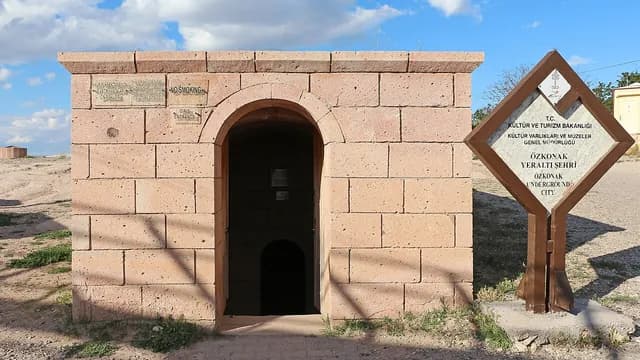
An underground city on the northern slope of Mount İdiş, found by chance by a farmer in 1972, known for its rolling stone doors and communication holes between levels.
Sarıhan Caravanserai
A tuff-stone caravanserai on the Aksaray–Kayseri caravan route, built in 1249 and counted among the last examples of Seljuk sultan's hans.
Sobesos Ancient City
A Roman–Byzantine city in Şahinefendi village, excavated since 2002, with 4th-century buildings and 1,500-year-old colorful floor mosaics.
Tatlarin Underground City
Acıgöl, Nevşehir
An underground city beneath 'Kale' hill in the town of Tatlarin, thought to have been used as a garrison or monastery, with two churches and many storerooms.
Uçhisar Castle
A giant rock mass hollowed out with rooms, at one of the highest points in Cappadocia; its summit offers a wide view reaching as far as Erciyes.
Kınık Höyük
Altunhisar, Niğde
One of the largest mounds of southern Cappadocia in Altunhisar, 20 meters high with a 24-hectare lower city; associated with the ancient kingdom of Tuwana.
Köşk Höyük
Bor, Niğde
A mound at Bahçeli, just east of the Roman Pool, known for its Neolithic and Chalcolithic skull burials with clay-modeled faces.
Niğde Castle
Merkez, Niğde
The castle surrounding the hill where old Niğde was founded, which gained importance in the Seljuk period and was repaired in 1740; the single standing bastion on the hill is the city's symbol.
Tyana Ancient City and Roman Aqueducts
The ancient city at Kemerhisar, the Hittites' Tuwanuwa and Rome's Tyana; about 1.5 km of its aqueducts, which carried water from the Roman Pool to the city, are still standing.
Alacahan Caravanserai
Kangal, Sivas
A stone caravanserai in the village of Alacahan on the Sivas–Malatya road, whose date is debated because it has no inscription.
Behram Paşa Hanı
Merkez, Sivas
A two-story city han with a courtyard, commissioned in 1576 by Behram Paşa, governor of Sivas, known for the lion figures on its entrance gate.
Divriği Castle and Kale Mosque
Divriği, Sivas
Mengujekid-period walls on a steep hill dominating the Çaltı Çayı valley, and the Kale Mosque with its inscription dated 1181.
Eğri Köprü (Crooked Bridge)
A multi-arched Seljuk-period stone bridge over the Kızılırmak, bending at an angle of about 130 degrees in the middle.
Hacı Murat Hanı
Koyulhisar, Sivas
The remains of a cut-stone caravanserai with standing walls in the Kelkit valley, on the old Suşehri–Niksar road.
Kesik Köprü (Gürcü Hüseyin Bridge)
A Seljuk bridge over the Kızılırmak built in 1213, with 19 spans and 326 meters long.
Koyulhisar Upper Castle (Kale-i Bala)
Castle remains on steep slopes east of the village of Yukarıkale, overlooking the Kelkit valley.
Samuha (Kayalıpınar) Hittite City
Yıldızeli, Sivas
The remains of the city of Samuha on the bank of the Kızılırmak, an important Hittite religious center and for a time a military base.
Sarissa (Kuşaklı) Hittite City
Altınyayla, Sivas
An important Hittite city mentioned in the Treaty of Kadesh as 'the Storm God of Sarissa', with a large temple and a Hittite dam.
Tecer Bridges
Ulaş, Sivas
Two historic stone bridges over the Tecer River, commissioned in 1885 by Halil Rıfat Paşa, Governor of Sivas.
Alişar Höyük
Sarıkaya, Yozgat
A city visited by Assyrian merchants, with layers stretching from the Neolithic to the Phrygian period, very probably the Kuššara of Hittite sources.
Behramşah Castle (Muşalikalesi)
Akdağmadeni, Yozgat
A castle dated to the 13th-century Seljuk period on a high hill north of the village of Muşalikalesi, and the 15th-century tombs at its foot.
Çadır Höyük
Sorgun, Yozgat
A mound on the Kanak Suyu plain with settlement from 5200 BC to Byzantium, proposed to be the Hittite cult city of Zippalanda.
Çeşka Underground City
Merkez, Yozgat
A multi-level underground settlement on a high hill northeast of the city, consisting of galleries, rooms and rock tombs.
Çınçınlı Sultan Hanı
Saraykent, Yozgat
A Seljuk caravanserai, ruined today, commissioned in 1240–1241 by Mahperi Hatun, wife of Sultan Alâeddin Keykubad I.
Delice Bridge (Yerköy)
Yerköy, Yozgat
A four-arched stone bridge over the Delice River, thought to stand on the site of a Roman-period bridge.
Karakız Hittite Quarry and Sculpture Workshop
A sculpture workshop in a Late Bronze Age Hittite quarry, with unfinished lion bases and a large basin.
Kerkenes (Pteria) Archaeological Site
A 6th-century BC Iron Age capital on Kerkenes Dağı, surrounded by 7 km of walls, thought to be Herodotus's Pteria.
Koşa Bridge
Şefaatli, Yozgat
A historic stone bridge with pointed arches over the Aksu in central Şefaatli, today reserved for pedestrians and cyclists.
Tavium Ancient City
The largest city of the Galatians' Trocmi tribe, in the village of Büyüknefes; an important road junction in the Roman period.
Uşaklı Höyük
A mound north of Kerkenes Dağı, a strong candidate for Zippalanda, the cult city of the Storm God, with monumental Hittite buildings.
Doğubayazıt Castle (Urartian Castle)
Doğubayazıt, Ağrı
A castle rising on the steep rocks called Belleburç above the old Bayazıt settlement, thought to be of Urartian origin and known for its rock tombs.
Meya Rock Settlement (Meya Caves)
Diyadin, Ağrı
An ancient rock settlement within the boundaries of Günbuldu village, bearing traces of different faiths and periods with rock-cut rooms, cross motifs, water channels and graves.
Şoşik Castle
Hamur, Ağrı
The remains of a historic castle rising on steep rocks about 22 km from the Hamur district center.
Tokluca Castle
A historic castle in the village of Tokluca in Diyadin, notable for its sections that descend underground by stairs.
Altaş (Uri) Castle
Merkez, Ardahan
A circular medieval castle on a pointed hill overlooking the Kura River, in the village of Altaş on the Ardahan–Hanak road.
Ardahan Castle
The symbol of Ardahan, rising in the middle of the city center on the bank of the Kura River; a castle with towered walls repaired by the Ottomans in the 16th century.
Göle, Ardahan
Castle remains rising at a steep point south of Kalecik village in Göle, where the village stream meets the Kura valley.
Kinzi Castle (Bağdaşen Castle)
A medieval castle with its walls largely standing, rising at around 2,200 meters east of Bilbilan Yaylası, about 30 km west of Ardahan.
Kırnav (Mglivani) Castle
Hanak, Ardahan
A medieval castle about 5 km south of Hanak, on the bank of the Hanak Stream, surviving with walls more than 7 meters high.
Savaşır (Çançahi) Castle
Posof, Ardahan
A medieval castle with high tower walls, rising on a pointed rock surrounded by valleys on three sides, in the village of Savaşır in Posof.
Şeytan Kalesi (Devil's Castle)
Çıldır, Ardahan
An impressive medieval castle near Çıldır, on a rock surrounded by cliffs on three sides, dominating the Karaçay canyon.
Veli (Sevimli) Castle
A large medieval castle built on a peninsula-shaped hill around which the Kura River winds on three sides, in the village of Sevimli in Hanak.
Kiğı (Görgeç) Castle
Kiğı, Bingöl
The remains of a medieval castle on rocky Görgeç Hill, northeast of Kiğı, around which the historic settlement of Kiğı was founded.
Kral Kızı (Genç) Castle
Genç, Bingöl
The remains of a castle on the hill just east of the Genç district center, believed to have given the district its name, about which various legends are told.
Monument to the 33 Martyrs
Merkez, Bingöl
A monument on Anıttepe in memory of the 33 unarmed soldiers who lost their lives in the attack on the Elazığ–Bingöl highway on 24 May 1993.
Zağ Rock Shelter Rooms
A historic rock settlement made up of rooms carved in tiers into a steep rock mass overlooking the Murat River, connected by steps and shafts.
Adilcevaz Castle
Adilcevaz, Bitlis
A castle on the Lake Van shore in Adilcevaz, part of whose walls extend into the lake, bearing traces of many periods from Roman to Ottoman.
Ahlat Seljuk Meydan Cemetery
Ahlat, Bitlis
An open-air museum on the UNESCO Tentative List, regarded as one of the largest Turkish-Islamic cemeteries of the Middle Ages, with thousands of monumental gravestones.
Ahlat Shore Castle (Ottoman Castle)
A rectangular Ottoman castle built on the shore of Lake Van in the 16th century after the Safavid destruction, containing the İskender Paşa and Kadı Mahmud mosques.
Bitlis Castle
Merkez, Bitlis
The historic castle forming the core of the city of Bitlis, built on a steep rock ridge between two streams and said to have given the city its name.
El-Aman Han (Rahva Caravanserai)
One of Anatolia's large caravanserais, built in 1579 by Hüsrev Paşa, beylerbeyi of Van, on the Bitlis–Tatvan road on the Rahva plain.
Harabeşehir and the Ahlat Cave Dwellings
A historic settlement area of hundreds of rock-cut caves in the Harabeşehir valley, where the remains of old Ahlat lie.
Kef Castle
A castle-city built by the Urartian king Rusa II on a rocky ridge at about 2,200 m on the foothills of Mount Süphan, north of Adilcevaz.
Tatvan Castle
Tatvan, Bitlis
A castle on the rocky hill on Tatvan's old Ahlat road, recorded as built by Zal Paşa in the reign of Süleyman the Magnificent, surviving as a ruin.
Ağın (Karamağara) Bridge
Ağın, Elazığ
A 520-meter cable-stayed bridge over the Keban Dam Lake, opened in 2015, named after the submerged Roman-period Karamağara Bridge.
Balak Gazi Monument and Viewing Terrace
Merkez, Elazığ
A monument in the park dedicated to the Artuqid Bey Belek (Balak) Gazi in Harput, and a viewing terrace overlooking Harput.
Harput Castle (Süt Kalesi)
A historic castle on the steep cliffs of the Harput plateau, dominating the Elazığ plain, with origins going back to the Urartians; also known as the 'Süt Kalesi' (Milk Castle).
Palu Castle
Palu, Elazığ
A castle on a steep rock on the banks of the Murat River, known for its cuneiform inscription from the reign of the Urartian king Menua, rock tunnels and stairs.
Altıntepe Urartian Fortress and Archaeological Site
Üzümlü, Erzincan
An Urartian fortress on a volcanic hill in the Erzincan plain, known for its temple, apadana and chamber tombs; it also contains a mosaic-floored church from the Byzantine period.
Kemah Castle
Kemah, Erzincan
A historic castle on steep cliffs overlooking the Karasu (Euphrates) valley, whose strength Evliya Çelebi praised, and which passed to the Ottomans in 1515 after a siege by Yavuz Sultan Selim.
Mama Hatun Caravanserai
Tercan, Erzincan
A 51x51-meter cut-stone caravanserai from the early 13th century on the Erzurum–Erzincan caravan route, commissioned by the Saltukid Melike Mama Hatun.
Monument to the Martyrs of the Battle of Otlukbeli
Otlukbeli, Erzincan
A monument opened in 2008 in memory of those who died at the Battle of Otlukbeli, fought on 11 August 1473 between Mehmed the Conqueror and the Akkoyunlu ruler Uzun Hasan.
Bardız Castle
Şenkaya, Erzurum
A medieval castle in the village of Gaziler (Bardız), its walls and towers largely standing, with a Georgian inscription at its entrance.
Çobandede Bridge
Köprüköy, Erzurum
A historic six-arched bridge about 130 m long, built of three-colored cut stone at the point where the Aras River forms, attributed to the Ilkhanid emir Çoban in the late 13th century.
Erzurum Castle and Tepsi Minaret
Yakutiye, Erzurum
An inner castle regarded as the city's oldest structure, founded in the Byzantine period and repaired by the Saltukids and Ottomans; its Tepsi Minaret was converted into a clock tower in the 19th century.
Hasankale (Pasinler Castle)
Pasinler, Erzurum
A historic castle rising on a hill at the foot of Mount Hasan Baba in the district center, which also gave Pasinler its old name, Hasankale.
İspir Castle
İspir, Erzurum
A restored medieval castle rising in terraces on a rock on the banks of the Çoruh River, containing the remains of a basilica and a 19th-century mosque.
Oltu Castle
Oltu, Erzurum
A restored castle on a rocky hill in the Oltu district center, overlooking the valley where the Oltu Stream forms, bearing traces of the Georgian, Seljuk and Ottoman periods.
Tortum Castle
Tortum, Erzurum
A medieval castle consisting of an inner and outer castle on a rocky hill in the village of Tortumkale, with the remains of a church inside.
Yazılıtaş Castle and Urartian Inscription
Horasan, Erzurum
Castle remains on a 2,240-meter rock mass near the village of Yazılıtaş in Horasan, and an Urartian cuneiform inscription carved at the foot of the rock.
Bay Castle
Merkez, Hakkari
Castle remains on a steep rocky hill at about 2,025 meters south of Hakkari, used from the Iron Age to the end of the Middle Ages.
Ejder Caravanserai (Harmandöven Caravanserai)
Merkez, Iğdır
A stone caravanserai in the village of Harmandöven on the Batumi–Tabriz caravan route, named after Şerafeddin Ejder, emir of Sürmeli.
Iğdır Genocide Monument and Museum (Soykırım Anıt-Müzesi)
A monument-museum complex at the ring road junction in Iğdır, consisting of a monument shaped like five swords reaching 43.5 meters and a museum beneath it.
Karakale (Sürmeli Castle)
The castle of the city of Sürmeli, on steep slopes overlooking the Aras River between Iğdır and Tuzluca, with a history going back to the Seljuk and Timurid periods.
Ani Archaeological Site
Merkez, Kars
One of the most impressive medieval cities of the Silk Road, on the edge of the Arpaçay valley, with walled churches, mosques, a palace and a caravanserai; a UNESCO World Heritage Site since 2016.
Borluk Valley Rock Paintings (Azat)
Prehistoric rock paintings showing hunting scenes carved on the cliffs of the Borluk Valley, near the village of Azat about 5–6 km from Kars.
Camuşlu Rock Paintings
Kağızman, Kars
An archaeological site around the village of Camuşlu in Kağızman, known for settlement traces going back to the Lower Paleolithic and paintings carved on the rocks.
Dikenli Tabya Martyrs' Memorial
Sarıkamış, Kars
One of the martyrs' memorials within the national park around Kızılçubuk, where the Sarıkamış Operation took place; a commemorative site at Kızılçubuk.
Kars Castle
A basalt castle, the symbol of the city, built in the Saltukid period in 1152–1153 on a rocky hill dominating the Kars Stream valley.
Keçivan Castle
A castle in the middle of the village of Tunçkaya (formerly Keçivan) in Kağızman, which has hosted one of the region's administrative centers since antiquity.
Taşköprü (Stone Bridge)
A three-arched basalt bridge in the narrow gorge of the Kars Stream, just below the castle, built in 1579 and renewed in the early 18th century.
Arapgir Millet Han
Arapgir, Malatya
A two-story historic han in the Arapgir bazaar, with a pool in its courtyard and shops around it, long a center of trade.
Arslantepe Mound
Battalgazi, Malatya
A large mound toured as an open-air museum, inscribed on the UNESCO World Heritage List in 2021, with settlement layers from the Chalcolithic Age to the Byzantine period.
Battalgazi (Old Malatya) City Walls
The historic wall line of Old Malatya, surrounding ancient Melitene, begun in the Roman period and completed under Byzantium, with remains still standing in places today.
Hekim Han (Taşhan)
Hekimhan, Malatya
A Seljuk caravanserai that gave the district its name, begun in 1218 and completed in the reign of Alâeddin Keykubad I, famous for its inscription in Arabic, Armenian and Syriac.
Kömürhan Bridge
Kale, Malatya
A crossing point on the Malatya–Elazığ road over the Euphrates, now the Karakaya Dam Lake, from the first bridge of 1932 to the new bridge opened in 2021.
Ozan Monument (Mescit)
Darende, Malatya
A Roman-period monument in the Ozan neighborhood of Darende, standing among apricot orchards near the Tohma River and called the 'Mescit' by villagers.
Silahtar Mustafa Paşa Caravanserai
A large Ottoman caravanserai with a courtyard and a covered section at the Alacakapı entrance to Old Malatya, built in 1637 by Mustafa Paşa, sword-bearer of Murad IV.
Suceyin Stone Bridge
A historic bridge west of Arapgir that crosses a deep canyon on a high cut-stone arch, notable for its style differing from Ottoman bridges.
Zengibar Castle (Darende)
A historic castle with a cut-stone gate rising on the steep cliffs west of the Tohma River, between the Somuncu Baba Tomb and the Ottoman cemetery.
Haspet Castle
Merkez, Muş
Castle ruins on the slope of Kızıl Ziyaret Dağı south of Muş, overlooking the plain, with walls and two towers partly standing.
Hatun (Hanım) Bridge
Malazgirt, Muş
A small historic stone bridge over the Adalar Çayı at the entrance to Malazgirt, dated to the Seljuk period.
Historic Murat Bridge
A historic stone bridge of Seljuk origin crossing the Murat River on the Muş–Varto road, with 12 spans and a length of about 143 meters.
Malazgirt 1071 Victory Monument
A monument built in memory of the 1071 Malazgirt Victory in a walled area east of the Malazgirt district center; within walking distance of the Malazgirt Museum.
Malazgirt Castle
A medieval castle of black stone surrounding old Malazgirt with a double row of walls, the scene of many sieges throughout history.
Mazgirt Castle
Mazgirt, Tunceli
A historic castle rising above the Mazgirt district center, linked to the Urartian period, at whose foot the district was built.
Pertek Castle
Pertek, Tunceli
A castle that became an island in the middle of the water when the Keban Dam Lake filled, with origins attributed to the Urartians and its present form from the Mengujekid period.
Anzaf Castles
İpekyolu, Van
An archaeological site on the Van–Özalp road consisting of two castles, lower and upper, from the time of the Urartian kings Ishpuini and Menua.
Ayanis Castle
Tuşba, Van
The last great castle of the Urartian King Rusa II, on a hill overlooking Lake Van, with a temple of Haldi and storage buildings uncovered by excavations.
Bendimahi Bridge
Muradiye, Van
A two-colored stone bridge dated to the late 13th century over the Bendimahi Çayı on the old Erciş–Tabriz caravan road; on the migration route of the pearl mullet.
Çavuştepe Castle (Sardurihinili)
Gürpınar, Van
An Urartian archaeological site on a ridge overlooking the Gürpınar Plain, founded by the Urartian King Sarduri II, with fine stonework, temples and a palace.
Hoşap Castle
An impressive castle on the Van–Hakkari road, built on a steep rock above the Hoşap Çayı, with its gate with lion reliefs and the remains of the Mahmudi palace.
Kırmızı Köprü (Red Bridge)
Bahçesaray, Van
A brick and stone bridge crossing the Müküs Çayı with a single pointed arch on the Bahçesaray–Hizan road, notable for the rooms on either side.
Meher Kapısı (Meher Gate)
A three-stepped niche carved into the rock at the foot of Zımzım Dağı; the principal source on Urartian religion with its inscription listing the Urartian gods and the sacrifices to be offered to them.
Muradiye (Kaldehar) Castle
The castle on the rocky hill in the Muradiye district center, rearranged in the time of Shah İsmail on Urartian foundations, which gave the district its name.
Old Van City
A large archaeological area at the southern foot of Van Castle, full of the remains of mosques, kümbets and churches of the historic city abandoned in the early 20th century.
Şamran (Menua) Canal
Edremit, Van
An ancient water canal commissioned by the Urartian King Menua about 2800 years ago, flowing between the gardens of Edremit and still used for irrigation.
Toprakkale (Rusahinili)
A castle founded by the Urartian king Rusa on the rocks of Zımzım Dağı just northeast of Van, known for its rich bronze finds.
Van Castle (Tushpa)
The citadel of Tushpa, capital of the Urartian Kingdom, built on a long rock rising on the shore of Lake Van; with royal inscriptions, rock tombs and lake views.
Zernaki Tepe
Erciş, Van
A walled ancient settlement on the plateau just north of Erciş, considered one of the earliest grid-plan cities of the Middle East with its right-angled streets.
Zeve Martyrs' Memorial (Zeve Şehitliği)
A martyrs' memorial and monument in Tuşba, built in memory of the Muslim villagers who lost their lives in the village of Zeve in 1915, during the First World War.
Adramytteion Ancient City
Burhaniye, Balıkesir
Remains of the ancient port city in Ören that gave its name to Edremit and overlooks the Gulf of Edremit.
Antandros Ancient City
Edremit, Balıkesir
A city of the Troad near Altınoluk, notable for its Roman terrace villa with wall paintings and mosaics.
Bigadiç Castle (Akhyraous)
Bigadiç, Balıkesir
The ruined outer walls of a castle known as Akhyraous in the Byzantine period, on the hill east of Bigadiç.
Daskyleion Ancient City
Bandırma, Balıkesir
The seat of the Persian Empire's satrapy of Hellespontine Phrygia, on a mound by Kuş Gölü (Lake Kuş) in Ergili.
Güvercin Bridge (Aesepus Bridge)
Gönen, Balıkesir
The remains of a late Roman bridge over the Gönen Çayı, known for the relieving openings in its piers.
Kisthene Ancient City (Kızçiftlik)
Gömeç, Balıkesir
The remains of Kisthene, an ancient Mysian coastal town known for its copper mines, on the Gömeç Plain opposite Lesbos (Midilli).
Kyzikos Ancient City
Erdek, Balıkesir
A powerful port city of the Propontis on the isthmus of the Kapıdağ Peninsula, with its giant Temple of Hadrian and amphitheater.
Saraylar Marble Quarries
Marmara, Balıkesir
The center of the Prokonnesian marble quarries worked since antiquity, with sarcophagus and column pieces displayed in the open.
Bilecik Castle
Merkez, Bilecik
The remains of the castle known as Belekoma in the Byzantine period and taken by Osman Gazi in 1299.
Harmankaya Castle
İnhisar, Bilecik
Castle remains on a rocky hill above a canyon, known as the home of Köse Mihal, Osman Gazi's comrade-in-arms.
Lefke Castle
Osmaneli, Bilecik
The remains of a Byzantine castle on a hill north of Osmaneli, overlooking the Sakarya valley.
Metristepe Victory Monument and Martyrs' Memorial
Bozüyük, Bilecik
The victory monument and martyrs' cemetery on Metristepe, İsmet Paşa's headquarters hill during the Battles of İnönü.
Mihal Bey Han and Mosque (Gölpazarı)
Gölpazarı, Bilecik
A han with alternating stone-and-brick masonry dating to the early Ottoman Beylik, and the mosque next to it, in Gölpazarı.
Vezirhan (Köprülü Mehmed Paşa Caravanserai)
A staging complex of a han, mosque and hammam commissioned by Köprülü Mehmed Paşa in the 17th century; the building that gave the town its name.
Yarhisar Castle
The remains of Yarhisar, one of the Byzantine castles Osman Gazi took at the same time as Bilecik.
Beştaş (Dikilitaş) Monument
İznik, Bursa
An obelisk about 12 meters tall, belonging to a Roman funerary monument, on a hill north of İznik.
Emir Han
Osmangazi, Bursa
One of Bursa's oldest hans, built as a source of income for the Orhan Gazi Complex, with an ablution fountain in its courtyard.
Irgandı Bridge
A bridge over the Gökdere lined with shops on both sides, one of the few bazaar bridges in the world.
Issız Han
Karacabey, Bursa
An early Ottoman caravanserai standing alone in the open countryside near Karacabey.
İznik City Walls and Lefke Gate
Walls about 5 km long encircling the city on all sides, with Roman-period gates still standing.
İznik Roman Theater
An ancient theater built in the Roman period on vaults raised over flat ground, brought to light by excavations.
İznik Tile Kilns Excavation Site
A site where excavations uncovered the workshops and kilns that produced the world-famous İznik tiles in the 15th–17th centuries.
İznik Underwater Basilica
The remains of an early Byzantine basilica lying in the shallow waters of İznik Gölü, about 20 meters offshore.
Koza Han
A han with a two-story courtyard and a small masjid at its center; for centuries the heart of the silk cocoon trade.
1915 Çanakkale Bridge
Lapseki, Çanakkale
Opened in 2022, the suspension bridge with the world's longest main span at 2,023 meters.
57th Regiment Martyrs' Memorial
Eceabat, Çanakkale
The memorial cemetery commemorating the 57th Infantry Regiment, which suffered heavy losses in the first counterattack against the Anzac landing.
Alexandria Troas Ancient City
Ezine, Çanakkale
The great port city of the Troad near Dalyan village, spread over 400 hectares, with a Roman bath and stadium.
Anzac Cove and Arıburnu
The narrow cove where Australian and New Zealand troops landed on April 25, 1915; host to dawn commemorations every year.
Asar Castle (Hadrian's Castle)
Yenice, Çanakkale
The remains of a hunting and watch castle attributed to Emperor Hadrian, on a wooded hill overlooking the Agonya plain.
Assos Ancient City
Ayvacık, Çanakkale
The city where Aristotle also lived, on a volcanic hill facing Lesbos (Midilli), with its walls, theater and necropolis.
Babakale Castle and Bababurnu
One of the last Ottoman castles, built in the 18th century against pirates, in Babakale village at the westernmost tip of Asia.
Bozcaada Castle
Bozcaada, Çanakkale
A moated island castle next to the ferry pier, rebuilt in the time of Mehmed the Conqueror.
Büyük Agonya Bridge
A stone bridge over the Agonya Çayı in Bayatlar village, popularly attributed to Alexander the Great and still in use.
Çanakkale Martyrs' Memorial
A 41.7-meter monument on Hisarlık Tepe above Morto Bay, built in memory of the Turkish soldiers who lost their lives in 1915.
Cape Helles (Ertuğrul Burnu) Memorial
An obelisk over 30 meters tall at the tip of the peninsula, commemorating more than 20,000 Commonwealth soldiers with no known grave.
Çimenlik Castle and Naval Museum
Merkez, Çanakkale
Kale-i Sultaniye, built under Mehmed the Conqueror to guard the narrowest point of the Strait; today visited for its Naval Museum and the replica of the minelayer Nusret.
Conkbayırı Memorials
One of the highest ridges of the Arıburnu front; the hill with the Mustafa Kemal statue, the Atatürk memorial and the New Zealand memorial.
Dardanos Ancient City and Tumulus
An old city of the Troad on the shore of the Strait near Kepez; known for its tumulus excavated in 1959.
Dur Yolcu Monument
Lines of poetry written in giant letters and a soldier figure on the Kilitbahir ridge, visible from the Strait and the Çanakkale shore.
Gallipoli Historical Site (Çanakkale Wars)
A 33,000-hectare historical site in the south of the Gallipoli Peninsula, home to the martyrs' cemeteries, memorials and trenches of the 1915 land and sea battles.
Kilitbahir Castle
The 'lock of the sea' from the time of Mehmed the Conqueror, with a cloverleaf-shaped keep at the narrowest point of the Strait.
Lone Pine (Kanlısırt) Memorial
A memorial and cemetery commemorating Australian and New Zealand soldiers with no known grave, at the site of the August 1915 battle of Kanlısırt.
Parion Ancient City
Biga, Çanakkale
A city on the Marmara coast by Kemer village, coming to light through ongoing excavations with its theater, odeion and necropolis.
Priapos (Karabiga Castle)
The walls of the ancient city of Priapos and of a medieval castle on the cape at Karabiga.
Respect to Mehmetçik Monument
A 1997 statue depicting a Turkish soldier carrying a wounded Australian officer in his arms.
Rumeli Mecidiye Battery and Seyit Onbaşı Monument
The battery near Kilitbahir where Seyit Onbaşı is said to have carried a heavy shell on his back on March 18, 1915.
Seddülbahir Castle
An Ottoman castle built in 1659 to guard the Aegean entrance to the Strait, reopened in 2023 after a long restoration.
Skepsis Ancient City
Bayramiç, Çanakkale
A city of the Troad at Kurşunlutepe, where Aristotle's library is said to have been kept for a time.
Temple of Apollo Smintheus (Smintheion)
A Hellenistic Ionic temple in Gülpınar dedicated to Apollo of the Mice, with an excavation house museum.
Temple of Athena at Assos
One of Anatolia's oldest Doric temples, at the summit of the Assos acropolis, with views of Lesbos (Midilli) and the Gulf of Edremit.
Trojan Horse (Kordon)
The giant wooden horse used in the 2004 film Troy; the most photographed spot on the Kordon.
Troy Ancient City
The legendary city on Hisarlık Tepesi showing nine superimposed layers of more than four thousand years of settlement; UNESCO World Heritage.
Adalet Kasrı (Justice Pavilion) and Sarayiçi
Merkez, Edirne
The only building of Edirne Palace to survive intact; a stone tower with a pyramidal roof, added under Süleyman the Magnificent.
Bayezid II Bridge (Tunca)
A bridge over the Tunca with six pointed arches, linking the Bayezid II Complex to the city.
Edirne Palace (Saray-ı Cedid-i Amire) Ruins
The ruins on the Tunca of the Saray-ı Cedid, the largest Ottoman palace after Topkapı; revival work is under way.
Ekmekçizade Ahmet Paşa Caravanserai
A monumental caravanserai south of the Selimiye, completed in 1610 and also known as Küpeli Han.
Enez Castle
Enez, Edirne
A castle with the character of an open-air museum, rising above ancient Ainos where the Meriç flows into the Aegean.
Gazi Mihal Bridge
One of the city's oldest bridges, over the Tunca, with Byzantine foundations and widened several times by the Ottomans.
Hoca Çeşme Mound
A mound on a rocky ridge near Enez, home to one of the oldest known Neolithic settlements in Thrace.
Lalapaşa Dolmens (Hacıdanişment)
Lalapaşa, Edirne
Dolmens: prehistoric tomb monuments built from stone blocks by the Thracians, in and around Hacıdanişment.
Macedonian Tower
The only surviving corner tower of the Roman-period city walls, surrounded by excavated wall and church remains.
Meriç Bridge
A 19th-century stone bridge over the Meriç River with a date pavilion in its middle, the city's favorite sunset viewpoint.
Rüstem Paşa Caravanserai
A large two-courtyard Ottoman caravanserai commissioned from Mimar Sinan by Grand Vizier Rüstem Paşa in 1554.
Saraçhane Bridge
A Tunca bridge on the way to Sarayiçi, commissioned in 1451 by Şehabettin Paşa, Beylerbey of Rumelia.
Uzunköprü (Ergene Bridge)
Uzunköprü, Edirne
At 1,392 meters over the Ergene, one of the longest stone bridges in the world; a 15th-century structure that gave the district its name.
Anadolu Fortress (Anadolu Hisarı)
Beykoz, İstanbul
A small fortress at the mouth of the Göksu Stream, built by Yıldırım Bayezid at the narrowest point of the Bosphorus in the late 14th century.
Anastasian Wall
Çatalca, İstanbul
The remains of the 'Long Wall', built in the early 6th century from the Black Sea to the Marmara to protect İstanbul from Thrace.
Aydos Castle
Sultanbeyli, İstanbul
The remains of a Byzantine castle on a spur of Aydos Hill in Sultanbeyli, taken by the Ottomans in the reign of Orhan Gazi.
Basilica Cistern (Yerebatan Sarnıcı)
Fatih, İstanbul
A giant 6th-century Byzantine underground reservoir where hundreds of columns rise from the water in dim light.
Bathonea Ancient City
Avcılar, İstanbul
A Hellenistic–Byzantine city under excavation on the northwest shore of Lake Küçükçekmece, with two ancient harbors and traces of a lighthouse.
Binbirdirek Cistern
A Byzantine cistern dated to the 4th–6th centuries, known for its tall double-shafted columns.
Bozdoğan Aqueduct (Aqueduct of Valens)
A 4th-century Roman–Byzantine aqueduct spanning Atatürk Boulevard.
Büyük Bent (Great Dam), Belgrad Forest
Sarıyer, İstanbul
A historic dam in the Belgrad Forest, the largest reservoir of the Ottoman Kırkçeşme system that carried water to İstanbul.
Galata Bridge
The Golden Horn bridge linking Eminönü and Karaköy, known for the fish restaurants on its lower level and the anglers on top.
Güzelce Aqueduct (Güzelce Kemer)
Sultangazi, İstanbul
An aqueduct in Cebeci built by Mimar Sinan on the Kırkçeşme water supply line.
Haramidere (Kapıağası) Bridge
Beylikdüzü, İstanbul
A three-arched stone bridge attributed to Mimar Sinan on the old Rumeli road between Küçükçekmece and Büyükçekmece.
Kanuni Sultan Süleyman Bridge
Büyükçekmece, İstanbul
A 636-meter, four-section stone bridge where Lake Büyükçekmece opens to the sea, which Mimar Sinan called his 'masterpiece'.
Karacaahmet Cemetery
Üsküdar, İstanbul
One of the largest and oldest cemeteries in Türkiye, in use in Üsküdar for centuries.
Küçükçekmece Bridge
Küçükçekmece, İstanbul
A 16th-century Ottoman stone bridge carrying the old Rumeli road at the mouth where Lake Küçükçekmece opens to the sea.
Küçükyalı Archaeopark (Bryas Palace)
Maltepe, İstanbul
An archaeological site in Küçükyalı, Maltepe, where 9th-century Byzantine palace and monastery remains are laid out as an open-air park.
Mağlova Aqueduct
Eyüpsultan, İstanbul
A monumental two-tiered aqueduct built by Mimar Sinan in the Alibey Stream valley for the Kırkçeşme water line.
Remains of the Damatris Palace
Sancaktepe, İstanbul
The surviving ruins in Samandıra of the summer palace built by the Byzantine emperors Tiberius II and Maurice.
Rumeli Fortress (Rumeli Hisarı)
A fortress built in four months in 1452 by Mehmed the Conqueror at the narrowest point of the Bosphorus, its towers overlooking the strait.
Şile Castle
Şile, İstanbul
A Genoese-era lookout castle on a small islet at the mouth of Şile harbor.
Silivri Castle (Selymbria)
Silivri, İstanbul
Kalepark in Silivri, laid out on a seaside bluff with the remains of a Byzantine castle and an open-air museum of stone artifacts.
Sultanahmet Square (Hippodrome)
The square on the site of the Hippodrome, the chariot-racing arena of Byzantium; home to the Obelisk, the Serpent Column and the Walled Obelisk.
Taksim Square and the Republic Monument
Beyoğlu, İstanbul
A monument from 1928 at the center of Taksim Square, depicting the War of Independence and the founding of the Republic.
Theodosian Land Walls
5th-century double Byzantine land walls and gates stretching about 6.5 km from the Marmara to the Golden Horn.
Tünel Funicular
One of the world's oldest underground funicular lines, opened in 1875 and running between Karaköy and Beyoğlu.
Uzunkemer Aqueduct
An Ottoman aqueduct in Kemerburgaz, the longest of the Kırkçeşme water line, attributed to Mimar Sinan.
Yedikule Fortress
A fortress enclosing the Byzantine Golden Gate, turned into a seven-towered citadel in the reign of Mehmed the Conqueror.
Yoros Castle
A Byzantine–Genoese castle on the hilltop of Anadolu Kavağı, overlooking where the Bosphorus opens onto the Black Sea.
Akarca Bridge
Pehlivanköy, Kırklareli
A 109-meter Ottoman stone bridge with seven pointed arches over the Ergene River at Akarca in Pehlivanköy, dated to the 16th century.
Alpullu Bridge
Babaeski, Kırklareli
The 124-meter Sinanlı Bridge over the Ergene, thought to have been commissioned from Mimar Sinan by Sokollu Mehmed Paşa.
Aşağı Pınar Mound
Merkez, Kırklareli
A Neolithic mound south of Kırklareli bearing traces of one of Europe's earliest farming villages.
Babaeski Bridge
A stone bridge from the reign of Murad IV dated 1633–34 over the Babaeski stream, with an inscription pavilion at its center.
Demirköy Foundry (Samakocuk)
Demirköy, Kırklareli
The excavated remains of a 15th-century foundry in the Istranca forests where the Ottomans produced cannonballs and iron.
Kanlıgeçit Mound
A mound west of Aşağı Pınar with a walled Early Bronze Age settlement and megaron buildings.
Kıyıköy (Midye) Castle
Vize, Kırklareli
The wall gates of ancient Salmydessos and Byzantine Midye, on the headland between the Pabuçdere and the Kazandere.
Lüleburgaz Sokollu Mehmed Paşa Bridge
Lüleburgaz, Kırklareli
A stone bridge over the Lüleburgaz stream, attributed to Mimar Sinan together with the Sokollu complex.
Pınarhisar Castle
Pınarhisar, Kırklareli
A Byzantine castle at the top of Pınarhisar, with two round towers with brick bonding still standing.
Polos Castle
A Middle and Late Byzantine castle on a 405-meter hill at the foot of the Istranca, near Yoğuntaş village.
Vize Castle and Ancient Theater
Concentric walls on the acropolis of Bizye, capital of the Thracian kings, and the Roman-period ancient theater on its slope.
Darıca Castle
Darıca, Kocaeli
The remains of a castle in Darıca, known in the Byzantine period as Tararion and Daritzion, which passed to the Ottomans after the 1329 Battle of Pelekanon.
Dilovası Mimar Sinan Bridge (Dilderesi Bridge)
Dilovası, Kocaeli
A three-arched stone bridge over the Dilderesi at Diliskelesi, on the Istanbul–Baghdad road, dated to the 16th century and attributed to Mimar Sinan.
Eskihisar Castle
Gebze, Kocaeli
A Byzantine-period castle on a hill commanding Eskihisar bay, controlling the entrance to the Gulf of İzmit.
Hannibal Monument
A monument to the Carthaginian commander Hannibal in the area near ancient Libyssa where he is believed to have died.
Hereke Castle
Körfez, Kocaeli
The remains of a small Byzantine-period castle and its walls on a hill in Hereke overlooking the gulf.
Nicomedia Ancient City
İzmit, Kocaeli
Ancient İzmit, capital of the Kingdom of Bithynia and later the eastern capital of the Roman Emperor Diocletian.
Bayezid II Bridge (Geyve)
Geyve, Sakarya
A multi-arched Ottoman stone bridge over the Sakarya River, built in the reign of Bayezid II.
Harmantepe Castle
Adapazarı, Sakarya
A 12th-13th-century Byzantine castle on a small hill on the Adapazarı Plain, on the Söğütlü boundary; the most intact Byzantine castle in Sakarya.
Justinian Bridge (Beşköprü)
Serdivan, Sakarya
A monumental stone bridge about 430 meters long, built over the Sakarya River in the 6th century by the Byzantine Emperor Justinian I.
Karasu Castle
Karasu, Sakarya
The remains of a medieval castle on the hill south of Karasu, overlooking the Black Sea coast and the plain.
Paşalar Castle (Karaceyş Castle)
Pamukova, Sakarya
The remains of a castle on a hill commanding the Pamukova and Geyve plains, thought to have been built in the Byzantine period and taken by the Ottomans in 1314.
Seyifler Castle
Ferizli, Sakarya
Castle remains thought to date from the Byzantine period, on a hill in Seyifler village in Ferizli.
Çorlu Castle Remains
Çorlu, Tekirdağ
Sections of wall in central Çorlu surviving from the castle of Tzirallum, which guarded the Byzantine road to Constantinople.
Heraion Teichos Ancient City
Süleymanpaşa, Tekirdağ
An ancient city on the seashore east of Tekirdağ, inhabited continuously from the 3rd millennium BC to the Middle Ages.
Perinthos (Herakleia) Ancient City
Marmaraereğlisi, Tekirdağ
Perinthos-Herakleia, an ancient port city founded by colonists from Samos that served as capital of the Roman province of Thrace.
Yalova Earthquake Monument
Merkez, Yalova
A monument on the waterfront commemorating those who lost their lives in the Marmara earthquake of August 17, 1999.
Ağzıkaraca Castle
İmamoğlu, Adana
A ruined castle on a flat hill near the village of Ağzıkaraca in İmamoğlu, known for its wall foundations and rock-cut pits.
Akköprü (Şekerpınarı Bridge)
Pozantı, Adana
A single-arched historic bridge over a tributary of the Seyhan in the Taurus Mountains, in use since at least the 9th century.
Anahşa Castle
A medieval castle on a sheer rock near Pozantı, overlooking the Taurus pass.
Anavarza (Anazarbos) Ancient City
Kozan, Adana
One of the most impressive ancient cities of Cilicia, with its triumphal arch, colonnaded street, mosaics and castle on a rocky hill.
Atatürk Park and Atatürk Monument
Seyhan, Adana
A bronze sculpture group by Ali Hadi Bara in Atatürk Park, opened in 1935 under the Jansen plan.
Ayas Castle and the Ancient Harbor of Aegeae
Yumurtalık, Adana
The sea castle of Ayas, the medieval port town where Marco Polo also called.
Dadaloğlu Statue
Yüreğir, Adana
A statue commemorating Dadaloğlu, Çukurova's famous Turkmen poet.
Feke Castle
Feke, Adana
A castle (Vahka) from the period of the Armenian Kingdom of Cilicia, on rocks overlooking the Göksu valley.
Haçin Castle
Saimbeyli, Adana
A medieval castle on a rocky hill within Saimbeyli (formerly Haçin).
Komana (Şar) Ancient City
Tufanbeyli, Adana
The remains of Cappadocian Komana, known for its great temple dedicated to the mother goddess Ma.
Kozan (Sis) Castle
The long-walled castle of Sis, former capital of the Armenian Kingdom of Cilicia, stretching along a ridge.
Kurtkulağı Caravanserai
Ceyhan, Adana
A cut-stone caravanserai built in the Ottoman period on the pilgrimage and trade route.
Magarsus Ancient City
Karataş, Adana
An ancient city on a hill on the Karataş coast, known for its theater overlooking the sea and the temple of Athena Magarsia.
Misis (Mopsuestia) Ancient City and Mosaic Museum
An ancient city on the banks of the Ceyhan River attributed to the legendary seer Mopsos, and a small museum housing the Noah's Ark mosaic.
Misis Bridge
A nine-arched Roman-era stone bridge over the Ceyhan River, repaired many times.
Sirkeli Höyük and Hittite Rock Relief
A mound on the banks of the Ceyhan with the oldest known Hittite rock relief in Anatolia, belonging to the Hittite king Muwatalli II.
Süleyman Tower
A pentagonal sea watchtower built by Süleyman the Magnificent in 1536 against pirates.
A stone bridge over the Seyhan River, standing since Roman times and considered one of the oldest bridges in the world still in use.
Tepebağ Mound (Höyük)
Adana's oldest settlement, continuously inhabited since the Early Bronze Age.
Tumlu (Dumlu) Castle
An Armenian-period castle on a volcanic hill rising from the middle of the plain.
Varda Bridge
Karaisalı, Adana
The famous stone viaduct of the Baghdad Railway, completed in 1912, spanning a deep valley in Hacıkırı.
Yılankale
A castle from the period of the Armenian Kingdom of Cilicia on a rocky hill overlooking the Ceyhan River.
Alanya Castle
Alanya, Antalya
A Seljuk castle encircling the peninsula, which rises about 250 meters from the sea, with 6.5 km of walls.
Alanya Shipyard and Tophane
The Seljuks' Mediterranean shipyard, begun in 1228, with five arched bays opening onto the sea.
Alara Castle
Gündoğmuş, Antalya
A castle built on a steep hill to protect caravans at Alara Han, known for its tunnel entrance.
Alara Han
A Seljuk caravanserai on the bank of the Alara Stream, built in 1231 as the first staging post on the Alanya–Konya caravan route.
Andriake Ancient Harbor
Demre, Antalya
The harbor of Myra; an ancient city at Çayağzı with a Hadrianic granary, agora and synagogue remains.
Antiocheia ad Cragum
Gazipaşa, Antalya
An ancient city near Güneyköy, built on slopes dropping steeply to the sea, named after King Antiochus IV of Commagene.
Antiphellos Ancient Theater and Kaş Rock Tombs
Kaş, Antalya
Ancient Habesos, within Kaş, with a Hellenistic theater facing the island of Meis and Lycian tombs scattered across town.
Aperlai Sunken City
A Lycian city on the Sıçak Peninsula that lived for 1,300 years, its shoreline remains partly under the sea.
Apollonia Ancient City
A Lycian League city on the Kekova road, built on a hill in Sahilkılınçlı village.
Arapsuyu Roman Bridge
Konyaaltı, Antalya
A well-preserved Roman bridge in Akdeniz City Park, at the foot of a mound associated with the colony of Olbia.
Arykanda Ancient City
Finike, Antalya
A Lycian city midway along the Elmalı–Finike road, built on five large terraces and famous for its views and baths.
Aspendos Ancient City and Theater
Serik, Antalya
One of Pamphylia's richest cities, with one of the best-preserved Roman theaters of the ancient world.
Aspendos Aqueduct
A Roman aqueduct that carried water to Aspendos, famous for its pressure towers.
Atatürk Mask
Kepez, Antalya
A giant 35 m relief of Atatürk's face at the entrance to Kepez City Forest.
Delikkemer (Patara Aqueduct)
A Roman pressurized water line of pierced stone blocks that carried water to Patara from 22.5 km away.
Evdir Han
Döşemealtı, Antalya
A Seljuk caravanserai on the Antalya–Isparta caravan route, built in the reign of İzzeddin Keykavus I.
Gagai Ancient City
Kumluca, Antalya
A Lycian coastal city in Mavikent that gave its name to the "gagates" (jet) stone.
Hadrian's Gate (Üçkapılar)
Muratpaşa, Antalya
A three-arched marble triumphal arch built to commemorate Roman Emperor Hadrian's visit to Antalya in AD 130.
Hıdırlık Tower
A 2nd-century cylindrical Roman tower overlooking the gulf, where Kaleiçi meets Karaalioğlu Park.
İotape Ancient City
A Cilician harbor city built around a small peninsula and cove right beside the Alanya–Gazipaşa road.
Kargı Han
Manavgat, Antalya
A historic caravanserai without an inscription in Beydiğin village, north of the Kargı Stream.
Kırkgöz Han
A Seljuk han built on the Antalya–Isparta road in the reign of Gıyaseddin Keyhüsrev II (1236–1246).
Kırkgöz Kemeri (Limyra Bridge)
One of the world's oldest segmental-arch bridges, crossing the Alakır Stream with 26 flat arches.
Kızıl Kule (Red Tower)
An octagonal Seljuk tower rising at the harbor entrance, also featured on Alanya's flag.
Köprüpazar (Aspendos) Bridge
A zigzag stone bridge built by the Seljuks in the 13th century on the piers of the Roman Eurymedon bridge.
Kyaneai Ancient City
One of Lycia's well-preserved inland cities, on the hill above Yavu village, with many sarcophagi and rock tombs.
Limyra Ancient City
An impressive ancient city at the foot of the Taurus, once one of Lycia's royal capitals, with its theater and rock tombs.
Myra Ancient City
An ancient city famous for its house-type Lycian tombs carved into sheer cliffs overlooking the Demre plain and its Roman theater.
Oluk Bridge (Selge Eurymedon Bridge)
A Roman bridge still in use, crossing the Köprüçay with a single arch at valley height.
Olympos Ancient City
A Lycian city in a deep valley, spread along a stream running to the seashore and intertwined with the forest.
Patara Ancient City
The harbor city where St. Nicholas was born, known for the assembly building of the Lycian League.
Perge Ancient City
Aksu, Antalya
Once the capital of Pamphylia, one of the region's most magnificent ancient cities, with its colonnaded street, Hellenistic gates and stadium.
Phaselis Ancient City
Kemer, Antalya
A Lycian harbor city among pine forests, with three harbors, an aqueduct and a main street running down to the shore.
Rhodiapolis Ancient City
A compact Roman-era Lycian city planned on narrow terrain on a hill 2.5 km north of Kumluca.
Şarapsa Han
A Seljuk caravanserai 15 km west of Alanya, built in the reign of Gıyaseddin Keyhüsrev II.
Seleukeia (Lyrbe) Ancient City
A Pamphylian mountain city near Bucakşeyhler in a pine forest, with a well-preserved agora and baths.
Selge Ancient City
A Pisidian mountain city at 1,250 meters in the Taurus, intertwined with Altınkaya village.
Selinus Ancient City and Gazipaşa Castle
A Cilician harbor city where Roman Emperor Trajan died in 117, spread over the hill and beach at the mouth of the Musa Stream.
Side Ancient City
One of the best-known cities of the classical period, with a theater, agora and wall gates intertwined with modern Side on the peninsula.
Sillyon Ancient City
A Pamphylian hill-fortress city built on a flat-topped rock mass between Perge and Aspendos.
Simena (Kaleköy)
A village opposite Kekova, reached only by sea or footpath, with its hilltop castle and Lycian sarcophagi submerged in the sea.
Syedra Ancient City
A harbor city between Alanya and Gazipaşa, built on a slope facing the sea and dating back to the 7th century BC.
Teimiussa and Üçağız
A small Lycian harbor settlement on the shore right beside Üçağız village, with sarcophagi and rock tombs.
Temple of Apollo, Side
A 2nd-century AD Roman temple at the tip of the peninsula, its five columns rising against the sea.
Termessos Ancient City
A Pisidian city hidden among pine forests on the slope of Güllük Dağı at about 1,000–1,150 m.
Trebenna Ancient City
An ancient city on the Lycia–Pamphylia border, built on a mountain slope near Geyikbayırı.
Ulusal Yükseliş Anıtı (National Rise Monument)
Hüseyin Gezer's 1964 Atatürk monument on Cumhuriyet Square.
Xanthos Ancient City
The capital of Lycia; the ancient city at Kınık on the UNESCO World Heritage list together with Letoon.
Bubon Ancient City
Gölhisar, Burdur
An ancient city on the hill above İbecik village, a member of the Kibyra tetrapolis; known for its bronze imperial statues.
Hacılar Höyük (Mound)
Merkez, Burdur
A Neolithic–Chalcolithic settlement of one of Anatolia's earliest farming communities; famous mother goddess figurines.
İncir Han
Bucak, Burdur
A 13th-century Seljuk han known for its portal with an oyster-shell motif.
Keraitai (Keraia) Ancient Settlement
A Hellenistic–Roman Pisidian settlement near Belören, known only from inscriptions.
Kibyra Ancient City
A UNESCO-candidate ancient city with a 10,000-seat stadium, a large odeon and a Medusa mosaic.
Kremna Ancient City
One of the five Roman colonies in Pisidia, built on a steep hill overlooking the Aksu valley.
Kuruçay Höyük (Mound)
A mound south of Burdur Lake with layers from the Neolithic to the Bronze Age.
Milyas (Mylias) Ancient City
A Taurus mountain city near Kocaaliler with a small theater carved into the bedrock and cisterns.
Olbasa Ancient City
Kemer, Burdur
A Pisidian city near Belenli village, refounded as a Roman colony under Augustus.
Sagalassos Ancient City
Ağlasun, Burdur
Pisidia's most magnificent city, 1,500 m up in the Taurus, where water still flows from the Antonine Fountain.
Sia Ancient City
A Pisidian city within the boundaries of Karaot village, with walls, a tower and monumental tombs preserved in pine forests.
Susuz Han
A Seljuk caravanserai built in the reign of Gıyaseddin Keyhüsrev II, with a geometrically decorated portal.
Akpınar Mound (Höyük)
Kumlu, Hatay
A mound where the Amik Plain meets the foothills of Kurt Dağı, inhabited from the Chalcolithic Age to the Ottoman period.
Alalakh (Tell Açana) Archaeological Site
Reyhanlı, Hatay
One of the most important mounds of the Amik Plain, the capital of the kingdom of Mukish in the Middle and Late Bronze Age, with its palaces and temples.
Antakya Castle and Walls (Silpius)
Antakya, Hatay
Ancient and medieval castle remains on top of Mount Habib-i Neccar (Silpius); a viewpoint looking down over the city.
Antakya Martyrs' Memorial and Monument
A martyrs' memorial and monument area in Antakya, laid out in memory of the martyrs.
Bakras Castle
Belen, Hatay
A medieval castle in the Amanos Mountains overlooking the Belen Pass and the Amik Plain; one of the important bases of the Knights Templar.
Belen Suleiman the Magnificent Caravanserai
The caravanserai of the complex founded in the time of Suleiman the Magnificent to secure the Belen Pass.
Beşikli Cave
Samandağ, Hatay
A Roman-period necropolis beside the Titus Tunnel, with many burial chambers carved into the rock.
Cin Kulesi (Jinn Tower)
Payas, Hatay
A medieval tower on the Payas shore, built to watch for threats from the sea.
Darb-ı Sak (Trapessac) Castle
Kırıkhan, Hatay
A medieval castle north of Kırıkhan, built in the 12th century by the Knights Templar.
Demirkapı (Iron Gate: Ancient Dam and City Gate)
A 6th-century Byzantine dam closing the valley between the Habib-i Neccar and Staurin mountains; one of the oldest surviving arch dams.
Epiphaneia Ancient City
Erzin, Hatay
An ancient city in eastern Cilicia near Erzin, with remains of an aqueduct, a theater and a colonnaded street.
Kinet Höyük (Ancient Issos)
Dörtyol, Hatay
A mound on the shore of the Gulf of İskenderun, identified with the ancient city of Issos, showing continuous settlement from the Bronze Age to the Middle Ages.
Kırıkhan Stone Bridge
A historic stone bridge on the old trade road in Kırıkhan.
Korean War Martyrs' Monument
İskenderun, Hatay
A monument in İskenderun commemorating the soldiers who lost their lives in the Korean War.
Koz (Kuseyr / Cursat) Castle
Altınözü, Hatay
A medieval castle built by the Principality of Antioch on the hill where the Kuseyr Çayı rises.
Payas Castle
An Ottoman-period castle right beside the Sokullu Complex, guarding the coastal road.
Payas Sokullu Mehmet Paşa Complex
A 16th-century complex attributed to Mimar Sinan; with its caravanserai, arasta, hamam and mosque, it came through the earthquakes undamaged.
Sarıseki Castle
The remains of a medieval castle on the shore of the Gulf of İskenderun, where the Belen road and coastal trade were controlled.
Seleucia Pieria Ancient City
The ancient port city of Antakya; remains of walls, the harbor basin and a necropolis spread around Çevlik.
Tayinat Mound (Höyük)
A Bronze and Iron Age mound at the bend of the Asi River on the Amik Plain; the remains of the Late Hittite city of Kunulua.
Tell Dhahab (Altıntepe) Mound
The 'golden hill' mound near Reyhanlı, settled since the Neolithic Age.
Trajan Aqueduct
Defne, Hatay
The surviving arches of the Roman-period waterway that carried water from the Daphne springs to ancient Antakya.
Vespasian Titus Tunnel
A Roman-period tunnel carved into the rock to protect the harbor of Seleucia Pieria from flood waters; it came through the earthquake undamaged and is open to visitors.
Adada Ancient City
Sütçüler, Isparta
A Roman-period Pisidian city in the foothills of the Taurus, with the Temple of Trajan and well-preserved buildings.
Cirimbolu Aqueduct
Uluborlu, Isparta
The surviving section of an arched water channel that carried water to ancient Apollonia.
Eğirdir Castle
Eğirdir, Isparta
A castle at the entrance to the peninsula stretching into the lake, used from the Byzantine period through the Seljuks and Hamidids.
Eğirdir Han
The remains of a Seljuk-period caravanserai south of Eğirdir.
Ertokuş Han (Kudret Han)
Gelendost, Isparta
A Seljuk han on the eastern shore of Lake Eğirdir, commissioned by Atabeg Mübarizeddin Ertokuş in the early 13th century.
Neapolis Ancient City
Şarkikaraağaç, Isparta
The remains of a Pisidian city northwest of Lake Beyşehir, near Kılıçarslan.
Pisidian Antioch (Pisidia Antiokheia) Ancient City
Yalvaç, Isparta
An ancient city famous for the Temple of Augustus and its aqueducts, where St. Paul gave his first recorded sermon.
Pisidian Antioch Aqueduct
The surviving piers of the Roman aqueduct that carried water to the ancient city from springs to the north.
Prostanna Ancient City
The remains of a Pisidian city that minted its own coins, on the slopes southwest of Eğirdir.
Sanctuary and Temple of Men
A hilltop sanctuary southeast of Antioch, dedicated to the moon god Men.
Seleukeia Sidera Ancient City
Atabey, Isparta
A Pisidian city near the village of Bayat (Selef), founded in the Seleucid period.
Sığırlık Castles
Castle remains on the steep hills west of Sütçüler that controlled the old road.
Uluborlu Castle and Apollonia (Sozopolis)
A historic castle rising on the acropolis of ancient Apollonia/Sozopolis and dominating the district.
Aşılı Castle
Andırın, Kahramanmaraş
A mountain castle in the foothills of the Taurus, north of Kadirli.
Azgıt Castle
A medieval castle near Andırın, in the foothills of the Taurus; earthquake impact recorded.
Bababurun Castle
Türkoğlu, Kahramanmaraş
A medieval castle southwest of Türkoğlu, in the foothills of the Amanos, overlooking the plain.
Geben Castle
A medieval castle on a steep rock overlooking the Geben valley.
Germanicia Ancient City and Floor Mosaics
Dulkadiroğlu, Kahramanmaraş
Roman-Byzantine floor mosaics that can be visited free of charge under protective roofs in the Bağlarbaşı and Dulkadiroğlu neighborhoods.
Göksun Mound (Höyük)
Göksun, Kahramanmaraş
A mound on the Göksun plain associated with the ancient settlement of Kokussos.
Haştırın Castle
A medieval castle south of Andırın overlooking the mountain roads; earthquake impact recorded.
Historic Ceyhan Bridge
Onikişubat, Kahramanmaraş
A historic stone bridge over the Ceyhan River connecting Maraş to the west; restoration work was carried out after the earthquake.
Kahramanmaraş Castle
A historic castle rising on the mound in the middle of the city; damaged in the earthquake, it reopened to visitors in September 2026 after restoration.
Karahöyük (Elbistan)
Elbistan, Kahramanmaraş
A mound going back to the Bronze Age, where a stele with a Hittite hieroglyphic inscription was found.
Adamkayalar
Silifke, Mersin
A mysterious site famous for Roman-period human reliefs carved into the sheer walls of a canyon.
Akkale Archaeological Site
Erdemli, Mersin
An archaeological site near the shore known for a large two-story Byzantine-period building complex and its giant cisterns.
Anemurium Ancient City
Anamur, Mersin
An ancient city on Cape Anamur, the southern tip of Anatolia, famous for its necropolis of hundreds of tomb structures.
Aphrodisias (Tisan) Ancient City
A quiet coastal ancient city on the Ovacık Peninsula, known for the remains of a church with a mosaic.
Çatıören and the Temple of Hermes
A quiet ancient settlement on the hills north of Kızkalesi, known for the remains of a temple of Hermes.
Cleopatra's Gate
Tarsus, Mersin
The single arched gate surviving from the ancient walls of Tarsus; associated with the legend of the meeting of Antony and Cleopatra.
Cyprus Martyrs' Memorial (Memorial Forest)
A symbolic martyrs' memorial where a tree has been planted in the name of each of the martyrs of the 1974 Cyprus Peace Operation.
Dağlı Castle
A small medieval mountain castle on the hills in the interior of Erdemli.
Demircili (Imbriogon) Monumental Tombs
Temple-shaped, two-story Roman-period monumental tombs on the Silifke–Uzuncaburç road.
Donuktaş
One of the largest building remains in Anatolia, consisting of the concrete core of a giant Roman-period temple.
Elaiussa Sebaste Ancient City
A coastal city built on a peninsula that was once an island, notable for the remains of a theater, an agora and a Byzantine palace.
Frederick Barbarossa Monument
A monument to Emperor Barbarossa, who drowned in the Göksu during the Third Crusade.
Gözlükule Mound (Höyük)
Tarsus's oldest settlement mound, inhabited from the Neolithic Age to the Roman period.
Gülek Castle
A medieval castle on a high rock controlling the historic pass across the Taurus.
Kanlıdivane (Kanytelis) Ancient City
An impressive ancient settlement built around a deep karstic sinkhole, with its churches and monumental tombs.
Kelenderis Ancient City
Aydıncık, Mersin
An ancient Phoenician–Samian colony at Aydıncık harbor, known for its famous mosaic depicting the harbor.
Kilise Tepe Mound (Höyük)
Mut, Mersin
A mound in the Göksu valley known for its layers stretching from the Early Bronze Age to Byzantium.
Kız Kalesi (Maiden's Castle / Sea Castle)
A medieval sea castle built on an islet about 200 meters offshore, the symbol of Mersin.
Korykos Land Castle
The coastal land castle of the ancient city of Korykos, directly opposite Kız Kalesi (Maiden's Castle).
Liman Kalesi (Harbor Castle)
A medieval castle on the rocky cape on the shore west of Taşucu.
Mamure Castle
One of Türkiye's best-preserved medieval castles, right on the sea, with more than 30 bastions.
Meydancık Castle
Gülnar, Mersin
One of the oldest castles of Rough Cilicia, with layers stretching from the Hittite period to the Persian and Hellenistic ages.
Mut Castle
A castle in central Mut, on the site of ancient Claudiopolis, repaired in the Karamanid period.
Mut Taşhan
An 18th-century Ottoman han, used today as a market place for women producers.
Nagidos Ancient City
Bozyazı, Mersin
An ancient port city on the Paşabeleni hill on the Bozyazı coast, founded by colonists from Samos.
Namrun (Lampron) Castle
Çamlıyayla, Mersin
One of the important castles of the Armenian Kingdom of Cilicia, on the rocky hill above Çamlıyayla.
Olba Aqueduct
A two-story Roman aqueduct 25 m high, built in 199 in the time of Septimius Severus.
Refah Martyrs' Monument
Akdeniz, Mersin
A seaside monument commemorating those who lost their lives on the Refah steamship, torpedoed in 1941.
Silifke Castle
A large medieval castle on the hill overlooking Silifke and the Göksu valley.
Silifke Stone Bridge (Taşköprü)
A stone bridge over the Göksu River with origins going back to the Roman period, still in use.
Softa Castle
An Armenian-period castle on a steep hill overlooking the sea, east of Bozyazı.
Soli Pompeiopolis Ancient City
Mezitli, Mersin
One of the important coastal cities of Cilicia, with its colonnaded street and ancient harbor.
Tarsus Ancient Roman Road
A Roman-period street paved with basalt blocks, uncovered by excavations in the town center.
Temple of Jupiter (Zeus)
The remains of a Roman-period temple in central Silifke, with a single column still standing.
Uzuncaburç (Diocaesarea) Ancient City
The sacred center of the Olba Kingdom, with the Temple of Zeus Olbios, its theater and five-story tower.
Yumuktepe Mound (Höyük)
Yenişehir, Mersin
A mound that is one of Anatolia's oldest continuous settlements, with layers going back to about 6300 BC.
Bahçe Castle
Bahçe, Osmaniye
A small medieval castle in the Bahçe district center, on the Amanos pass road.
Bahçe Pass (Amanian Gates)
A mountain pass linking Cilicia and Syria, called the 'Amanian Gates' in antiquity.
Bodrumkale (Kastabala Castle)
Merkez, Osmaniye
A medieval castle on a rocky hill dominating the ancient city of Kastabala.
Çardak Castle
The remains of a medieval castle east of Osmaniye, overlooking the plain.
Domuztepe Archaeological Site
Düziçi, Osmaniye
A Late Hittite settlement on the east bank of the Ceyhan River, opposite Karatepe; the site where the famous storm god statue was found.
Düziçi Floor Mosaic and Archaeological Site (İrenopolis)
An archaeological site associated with the ancient city of İrenopolis, where a floor mosaic has been uncovered.
Haruniye (Harun al-Rashid) Castle
A border castle built in the 8th century in the time of the Abbasid Caliph Harun al-Rashid.
Hasanbeyli Castle
Hasanbeyli, Osmaniye
A watch castle rising on the Hasanbeyli mound.
Hemite (Amouda) Castle
A medieval castle on a hill dominating the Ceyhan River, also used by the Teutonic Knights.
Hemite Rock Monument
A Hittite relief and inscription carved into the rock on the bank of the Ceyhan River.
Hierapolis-Kastabala Ancient City
One of the impressive ancient cities of Çukurova, with its colonnaded street, theater, temple and Bodrumkale on the rocky hill.
Mitisin Castle
A tower-castle in the Nur Mountains on the Zorkun road, watching over the plain.
Savranda Castle
One of the strongest mountain castles of Cilicia with its 12 bastions, guarding the Amanos pass.
Toprakkale Castle
Toprakkale, Osmaniye
A medieval castle built of black basalt stones, watching over the roads linking Çukurova to the Amanos passes.
Arsameia Archaeological Site (Eski Kâhta)
Kâhta, Adıyaman
The summer capital of the Kingdom of Commagene; a sanctuary famous for the relief of Antiochus shaking hands with Heracles and the longest Greek inscription in Anatolia.
Cendere Bridge (Septimius Severus Bridge)
The widest surviving single-arched Roman bridge, with a span of 34.2 meters, built around AD 200 in honor of Roman Emperor Septimius Severus and his family.
Gerger Castle
Gerger, Adıyaman
A historic castle on steep cliffs overlooking the Euphrates, dating back to the 2nd century BC, with the remains of a mosque at its entrance.
German Bridge (Alman Köprüsü)
Gölbaşı, Adıyaman
A registered 280-meter railway bridge with 7 arches over the Göksu Stream, designed by German engineers and built in 1929.
Haydaran Rock Tombs
Merkez, Adıyaman
A Commagene-period site near Taşgedik with rock tombs and a relief of the Sun God Helios shaking hands with King Antiochus.
Kâhta Yeni Kale
A medieval castle on a steep rock overlooking the Kâhta Stream valley, notable for its Mamluk inscriptions and its messenger-pigeon dovecote.
Karakuş Tumulus
A monumental tomb built for the women of the Commagene royal family, surrounded by columns, one topped with an eagle statue.
Malpınarı Rock Inscription
A Late Hittite hieroglyphic inscription carved into the rock in the hamlet of Malpınar, with traces of an ancient settlement around it.
Old Besni and the Ulu Mosque Minaret
Besni, Adıyaman
Among the hillside ruins of the abandoned old town of Besni, the Ulu Mosque survives through its minaret, built in 1565 by the architect Numan el-Osmani.
Perre Ancient City
One of the five great cities of the Kingdom of Commagene; an ancient city in the Örenli (Pirin) neighborhood with hundreds of rock tombs and a Roman fountain that still flows.
Sesönk (Dikilitaş) Monumental Tomb
A monumental tomb tumulus on Kızıldağ, built by King Mithridates II of Commagene and surrounded by columns with reliefs of a woman, a man and lions.
Sofraz Monumental Tomb (Tumulus)
A 1st-century AD monumental tomb near Sofraz (Üçgöz), consisting of a dromos, a corridor and a burial chamber with sarcophagi beneath a 15-meter earth mound.
Turuş Rock Tombs
Roman-era rock tombs just west of the Adıyaman–Şanlıurfa road, reached by 10–13 steps, some with reliefs on their doorways.
Hasankeyf Castle and Old Town
Hasankeyf, Batman
The castle rock rising from the Ilısu Dam lake; although the lower town was submerged in 2020, the upper castle has reopened to visitors with walking paths.
Kozluk (Hazo) Castle
Kozluk, Batman
The historic Hazo castle on a hill in Kozluk's old Kale neighborhood, overlooking the district and the surrounding plain.
Çayönü Tepesi
Ergani, Diyarbakır
A Neolithic settlement about 12,000 years old that continuously documents the transition from hunting and gathering to farming.
Çüngüş Bridge
Çüngüş, Diyarbakır
A historic single-span stone bridge with a pointed arch over the Çüngüş Stream, its piers resting on natural rock.
Devegeçidi Bridge
Yenişehir, Diyarbakır
A historic bridge with black stone facing over the Devegeçidi Stream, about 20 km north of the city, and the picnic area around it.
Diyarbakır City Walls
Sur, Diyarbakır
Basalt city walls on the UNESCO World Heritage List, enclosing the walled city (Suriçi) with four main gates and dozens of towers.
Eğil Castle and Rock Tombs
Eğil, Diyarbakır
A castle of Assyrian origin on a monolithic rock surrounded on three sides by deep valleys; its west face bears a relief of a king with a cuneiform inscription.
Haburman Bridge
Çermik, Diyarbakır
A single large-arched stone bridge over the Sinek Stream, commissioned in 1179–80 by the Artuqid princess Zübeyde Hatun.
Hasan Paşa Han
A two-story Ottoman han opposite the Ulu Mosque, built between 1572 and 1575 by Vezirzade Hasan Paşa.
Hilar Caves (Rock Tombs)
Rock-cut caves just south of Çayönü, used as tombs between AD 100 and 325; registered as an archaeological site in 2024.
İç Kale (Inner Citadel)
A walled inner citadel regarded as the city's first settlement, home to the Amida Mound, the Artuqid Arch and museum buildings.
Kefrum Castle
Kulp, Diyarbakır
A structure with inner and outer castles on a steep height in Kulp, known as the only castle in the region with walls of brick.
Malabadi Bridge
Silvan, Diyarbakır
A bridge over the Batman Stream built in 1147 by the Artuqid Timurtaş, one of the widest-span stone bridges in the world with its giant pointed arch.
Ten-Eyed (Tigris) Bridge (On Gözlü Köprü)
A basalt bridge from the Marwanid period with an inscription dated 1065, stretching across the Tigris on ten arches.
Zerzevan Castle and Mithras Temple
Çınar, Diyarbakır
A Roman frontier garrison on a rocky hill on the Diyarbakır–Mardin road, famous for its underground Mithras temple.
Büdeyri Han
Şahinbey, Gaziantep
A 19th-century han whose han and soap-workshop sections are connected on the upper floor, regarded as unique in plan among Gaziantep's hans.
Dülük Ancient City and Dülükbaba Nature Park
Şehitkamil, Gaziantep
The ancient city of Doliche, birthplace of the cult of Jupiter Dolichenus; its underground Mithras temples and rock tombs lie within a nature park covered with pine forests.
Gaziantep Castle
A round, 12-towered castle rising on the mound in the middle of the city; heavily damaged in the 2023 earthquakes, its restoration was completed in 2025.
Karasu Rock Relief
Araban, Gaziantep
A Late Hittite relief in Araban carved on a rock face about 200 meters above the river in a limestone gorge cut by the Karasu Stream, showing a protective god standing on a stag.
Karkamış Ancient City (Archaeopark)
Karkamış, Gaziantep
The great Late Hittite capital on the west bank of the Euphrates; part of the city, also excavated by T. E. Lawrence, has been open to visitors as an archaeopark since 2019.
Pişirici Kastel
One of the best-known examples of 'kastels', the underground water structures unique to Gaziantep; it combines a fountain, an ablution area and a masjid.
Rumkale
Nizip, Gaziantep
A medieval castle on a steep rock where the Euphrates and the Merzimen Stream meet, once the seat of the Armenian catholicoses; reached by boat in the middle of the dam lake.
Tilbaşar Castle (Turbessel)
Oğuzeli, Gaziantep
Turbessel, rising on the mound of a Bronze Age city near Gündoğan, an important castle of the County of Edessa during the Crusades.
Tilmen Höyük
İslahiye, Gaziantep
A mound surrounded by branches of the Karasu, whose Middle Bronze Age palace and walls have been repaired and laid out like an open-air archaeological park.
Tütün Han (Tobacco Han)
A two-story, single-courtyard Ottoman han dated to the mid-18th century, notable for its black-and-white stonework.
Yesemek Open-Air Museum and Sculpture Workshop
The largest known Hittite quarry and sculpture workshop of the ancient Near East, where hundreds of unfinished basalt lions, sphinxes and reliefs lie on the hillside.
Zeugma Ancient City
An ancient city on the banks of the Euphrates, founded by Seleucus I and famous for its mosaic-decorated Roman villas; the excavated villas are toured under protective roofs.
Zincirli Höyük (Sam'al)
The capital of the Late Hittite and Aramean Kingdom of Sam'al; a large mound with the remains of a palace and citadel surrounded by a double wall.
Oylum Höyük
Merkez, Kilis
One of the region's largest mounds on the Kilis Plain, with a 460×320-meter base and a height of up to 37 meters; traces of settlement from the Chalcolithic to the Iron Age.
Ravanda Castle
Polateli, Kilis
A medieval castle on a conical hill east of the Afrin Stream, reached by 255 steps, an important base of the County of Edessa in the Crusader period.
Başkavak Bridge
Savur, Mardin
A 14-span stone bridge over the Savur Çayı, built in 1755 and repaired in 1861 according to its inscription.
Çelbira Ancient Grape Press
Artuklu, Mardin
An ancient wine and pekmez press dating to the 4th century, where 105 cisterns and 10 grape-crushing areas were uncovered on slopes with rock-cut tombs.
Dara Ancient City
A garrison city on the Eastern Roman border with the Sasanians; an archaeological site in the village of Oğuz (Dara) with giant cisterns, a necropolis of rock tombs and wall remains.
Dermetinan Castle
Mazıdağı, Mardin
The ruins of a Byzantine castle perched like an eagle's nest on a 150-meter hill, which Timur's armies are said to have captured only in 20 days.
Gırnavaz Mound (Höyük)
Nusaybin, Mardin
A mound and place of pilgrimage on the bank of the Çağ Çağ River, inhabited from the 4th millennium BC to the 7th century BC and associated with the jinn in folk belief.
Rabat Castle
Derik, Mardin
The ruins of a large rectangular castle at Hisaraltı, west of Derik, with 15 bastions and corner towers, repaired in the Artuqid period.
Savur Castle and Old Savur
The castle hill of Savur, built on a mountain slope and surrounded by stone houses, rock houses and a historic mosque; the historic core of the district.
Birecik Castle
Birecik, Şanlıurfa
A historic castle on a white limestone hill on the bank of the Euphrates, also called the 'White Castle', bearing Mamluk repair inscriptions.
Göbeklitepe
Haliliye, Şanlıurfa
One of the world's oldest monumental structures, dated to around 9600 BC and known for its T-shaped pillars with reliefs; a UNESCO World Heritage Site since 2018.
Gümrük Hanı and the Historic Covered Bazaar
Eyyübiye, Şanlıurfa
The city's liveliest meeting place, with its arcaded courtyard commissioned by Behram Paşa in the 16th century; together with the surrounding Kazzaz Pazarı and bedesten, the heart of the historic bazaar.
Han el-Ba'rur Caravanserai
Harran, Şanlıurfa
The remains of an Ayyubid-period caravanserai built in 1228–1229 on the old caravan road linking the Harran Plain to the Tektek Mountains.
Harran Archaeological Site and Harran Ulu Mosque
The mound of ancient Harran, center of the cult of the Moon god Sin, and the remains of the Ulu Mosque commissioned by the Umayyad caliph Marwan II in 744–750, considered the oldest mosque in Anatolia.
Harran Castle
The citadel connected to the walls at the southeast corner of the ancient city, its present structure largely from the Ayyubid period of around 1200.
Karahantepe
A Neolithic settlement in the Tek Tek Mountains contemporary with Göbeklitepe, with a ritual structure with a human head carved into the bedrock and hundreds of pillars.
Kızılkoyun Necropolis
An ancient cemetery of numerous rock tombs from the Roman and Byzantine periods on the rocky slope between Balıklıgöl and the museum.
Nissibi Bridge
Siverek, Şanlıurfa
A 610-meter cable-stayed bridge joining the two shores of the Atatürk Dam Lake; its surroundings are known for sunsets and lake views.
Şanlıurfa Castle
A castle on Damlacık Hill just south of Balıklıgöl, a symbol of the city with its two columns called 'Nimrod's catapult'.
Soğmatar Ancient City
An ancient cult center in the Tektek Mountains with the sacred hill where the people of Harran worshipped the Moon god Sin and the planetary gods, a cave with reliefs and monumental tombs.
Şuayb City (Şuayb Şehri)
An ancient settlement from the Roman period with rock-cut houses and tombs, where the Prophet Shuaib is believed to have lived.
Erzen (Arzen) Archaeological Site
Kurtalan, Siirt
The remains of an ancient city on the bank of the Garzan Çayı, the center of the Arzanene region in Late Antiquity, identified by some researchers with Tigranakert.
Cizre Castle (Birca Belek)
Cizre, Şırnak
Cizre's historic castle on the bank of the Tigris, consisting of inner and outer sections and containing the Hamidiye Barracks; excavation and restoration are ongoing.