25 · City guide
Erzurum
City of Seljuk stonework, Palandöken snow and cağ kebab
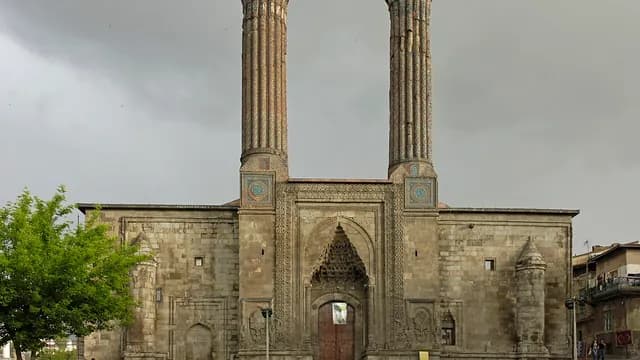
Erzurum is a city at an elevation of about 1,900 meters, where the Erzurum Plain meets Mount Palandöken. Known as Theodosiopolis in the Byzantine period, the city became one of the important centers of the east under the Saltukids and Seljuks; the Çifte Minareli Madrasa (Double Minaret Madrasa), the Ulu Mosque (Grand Mosque), the Üç Kümbetler (Three Tombs) and the Yakutiye Madrasa carry this heritage within walking distance of one another. The Tepsi Minaret and the clock tower inside the castle form the city's oldest silhouette. The Aziziye Redoubt, which defended the city in the 1877–78 Ottoman-Russian War, and the grave of Nene Hatun are inside Nene Hatun Historical National Park; the building of the Erzurum Congress, convened in 1919, can now be visited as a museum. Palandöken, just south of the city, is one of Turkey's main ski resorts. Within the province, Tortum Waterfall and Tortum Lake in Uzundere, Narman's red fairy chimneys, medieval Georgian buildings such as Haho and Öşk Vank, the Kop Dağı martyrs' memorial in Aşkale, and the Oltu stone craftsmen of Oltu make up a route of several days.
Machine translated — This content was machine-translated and may differ from the original Turkish text.36
Places
0
Routes
0
Badges
Where shall we explore?
 Machine translated — This content was machine-translated and may differ from the original Turkish text.
Tomb (türbe)
Tomb of Abdurrahman Gazi
Palandöken, Erzurum
A place of pilgrimage at the foot of Palandöken, popularly believed to belong to one of the standard-bearers of the early Islamic period, given its tomb building in 1796.
- Machine translated — This content was machine-translated and may differ from the original Turkish text.
Tomb (türbe)
Tomb of Âşık Sümmani
Narman, Erzurum
The modest tomb, in his native village of Samikale, of Âşık Sümmani (1861–1915) of Narman, one of the great masters of the Eastern Anatolian minstrel (âşık) tradition.
 Machine translated — This content was machine-translated and may differ from the original Turkish text.
Church
Bana Cathedral (Penek Church)
Şenkaya, Erzurum
The remains of a medieval cathedral near the village of Penek, with a quatrefoil plan and a circular outer wall, scene of the coronation and wedding of Georgian Bagrationi kings.
- Machine translated — This content was machine-translated and may differ from the original Turkish text.
Castle
Bardız Castle
Şenkaya, Erzurum
A medieval castle in the village of Gaziler (Bardız), its walls and towers largely standing, with a Georgian inscription at its entrance.
 Machine translated — This content was machine-translated and may differ from the original Turkish text.
Madrasa and külliye (complex)
Çifte Minareli Madrasa (Double Minaret Madrasa)
Yakutiye, Erzurum
A Seljuk-period madrasa, symbol of Erzurum with its tile-decorated twin minarets, regarded as the largest example in Anatolia of open-courtyard madrasas.
 Machine translated — This content was machine-translated and may differ from the original Turkish text.
Bridge
Çobandede Bridge
Köprüköy, Erzurum
A historic six-arched bridge about 130 m long, built of three-colored cut stone at the point where the Aras River forms, attributed to the Ilkhanid emir Çoban in the late 13th century.
 Machine translated — This content was machine-translated and may differ from the original Turkish text.
House museum
Erzurum Atatürk House Museum
Yakutiye, Erzurum
A historic mansion where Mustafa Kemal Paşa and his companions stayed and worked for 52 days during the Erzurum Congress of 1919, a museum since 1984.
 Machine translated — This content was machine-translated and may differ from the original Turkish text.
Castle
Erzurum Castle and Tepsi Minaret
Yakutiye, Erzurum
An inner castle regarded as the city's oldest structure, founded in the Byzantine period and repaired by the Saltukids and Ottomans; its Tepsi Minaret was converted into a clock tower in the 19th century.
 Machine translated — This content was machine-translated and may differ from the original Turkish text.
Museum
Erzurum Museum
Yakutiye, Erzurum
The city museum, in its new building next to the Üç Kümbetler since 2023, known for artifacts from the Chalcolithic Age to the Republic and its mammoth fossil.
 Machine translated — This content was machine-translated and may differ from the original Turkish text.
Mosque
Erzurum Ulu Mosque (Grand Mosque)
Yakutiye, Erzurum
The city's oldest and largest mosque, built in 1179 in the Saltukid period; it stands out for its dome with a wooden lantern roof and its wide prayer hall with many piers.
 Machine translated — This content was machine-translated and may differ from the original Turkish text.
Monastery
Haho Monastery (Taş Camii)
Tortum, Erzurum
A Georgian monastery founded in the 10th century in the village of Bağbaşı; its main church was converted into a mosque in the 19th century and is still used today as the Taş Camii (Stone Mosque).
 Machine translated — This content was machine-translated and may differ from the original Turkish text.
Castle
Hasankale (Pasinler Castle)
Pasinler, Erzurum
A historic castle rising on a hill at the foot of Mount Hasan Baba in the district center, which also gave Pasinler its old name, Hasankale.
- Machine translated — This content was machine-translated and may differ from the original Turkish text.
Canyon
Hınıs Canyon
Hınıs, Erzurum
A canyon of about 7 kilometers carved by the Hınıs Stream right next to the Hınıs district center; registered as a strictly protected sensitive area in 2021.
- Machine translated — This content was machine-translated and may differ from the original Turkish text.
Mosque
Hınıs Ulu Mosque (Dere Mosque)
Hınıs, Erzurum
A historic mosque inside Hınıs Canyon, built in 1734 by Alaeddin Bey, one of the beys of Muş, also popularly known as the Dere Mosque.
 Machine translated — This content was machine-translated and may differ from the original Turkish text.
Hot spring
Ilıca Hot Springs
Aziziye, Erzurum
A sodium bicarbonate thermal spring at 38–39 °C, about 15 km from Erzurum, in use since the Seljuk and Ottoman periods.
 Machine translated — This content was machine-translated and may differ from the original Turkish text.
Castle
İspir Castle
İspir, Erzurum
A restored medieval castle rising in terraces on a rock on the banks of the Çoruh River, containing the remains of a basilica and a 19th-century mosque.
 Machine translated — This content was machine-translated and may differ from the original Turkish text.
Lake
İspir Yedigöller (Ovit Glacial Lakes)
İspir, Erzurum
Glacial lakes lined up between granite walls at 2,800–3,000 m in the south of the Kaçkar Mountains; a demanding summer route reached via Moryayla.
- Machine translated — This content was machine-translated and may differ from the original Turkish text.
Ski resort
Kandilli Ski Center
Aşkale, Erzurum
One of Türkiye's main Nordic skiing facilities, built for the 2011 Winter Universiade, with cross-country and biathlon courses.
- Machine translated — This content was machine-translated and may differ from the original Turkish text.
Ski resort
Konaklı Ski Center
Palandöken, Erzurum
A ski center on the western slopes of the Palandöken Mountains, about 20 km from the city center, built for the alpine events of the 2011 Winter Universiade.
 Machine translated — This content was machine-translated and may differ from the original Turkish text.
National park
Kop Mountain Defense Historical National Park and Kop Martyrs' Monument
Aşkale, Erzurum
A historical national park declared in 2016, scene of the Kop defense in the First World War, remembered with its martyrs' monument at the Kop Pass at 2,409 m.
 Machine translated — This content was machine-translated and may differ from the original Turkish text.
Mosque
Lala Mustafa Paşa Mosque
Yakutiye, Erzurum
A central-domed building attributed to Mimar Sinan, commissioned in 1562 according to its inscription by Lala Mustafa Paşa, beylerbeyi of Erzurum, and regarded as the city's most important Ottoman mosque.
 Machine translated — This content was machine-translated and may differ from the original Turkish text.
Natural monument
Narman Fairy Chimneys Natural Monument
Narman, Erzurum
An area known as the 'Land of the Red Fairies', declared a natural monument in 2018, where sedimentary rocks colored red by iron oxide have been turned by wind and rain into columns and towers.
 Machine translated — This content was machine-translated and may differ from the original Turkish text.
National park
Nene Hatun Historical National Park (Aziziye Redoubt and Grave of Nene Hatun)
Palandöken, Erzurum
A historical national park declared in 2009, protecting the defense in which the people retook the Aziziye Redoubt in the '93 War and the grave of Nene Hatun, the symbol of this resistance.
 Machine translated — This content was machine-translated and may differ from the original Turkish text.
Castle
Oltu Castle
Oltu, Erzurum
A restored castle on a rocky hill in the Oltu district center, overlooking the valley where the Oltu Stream forms, bearing traces of the Georgian, Seljuk and Ottoman periods.
 Machine translated — This content was machine-translated and may differ from the original Turkish text.
Monastery
Öşk Vank (Oshki Monastery)
Uzundere, Erzurum
One of the largest and most complex churches of the Georgian Orthodox world, built by the rulers of Tao in the second half of the 10th century in the village of Çamlıyamaç.
 Machine translated — This content was machine-translated and may differ from the original Turkish text.
Ski resort
Palandöken Ski Center
Palandöken, Erzurum
One of Türkiye's leading ski centers, about 10 minutes from the city center, with runs between 2,200 and 3,176 m, a gondola and floodlit night skiing.
- Machine translated — This content was machine-translated and may differ from the original Turkish text.
Hot spring
Pasinler Hot Springs
Pasinler, Erzurum
Historic hot springs at the northern foot of Mount Hasan Baba, the oldest part going back to 1390, known for their bicarbonate-rich, carbonated hot waters.
 Machine translated — This content was machine-translated and may differ from the original Turkish text.
Bazaar and arasta
Rüstem Paşa Bedesten (Taşhan)
Yakutiye, Erzurum
A two-story courtyard han built in the 16th century in the name of Grand Vizier Rüstem Paşa; today the city's Oltu stone bazaar, with the workshops and shops of Oltu stone craftsmen.
- Machine translated — This content was machine-translated and may differ from the original Turkish text.
Church
Taoskari Church
Olur, Erzurum
A 9th-century Georgian church standing in a garden in the village of Çataksu (Taoskari) in Olur; one of the medieval buildings of the historic Tao region.
 Machine translated — This content was machine-translated and may differ from the original Turkish text.
Lake
Lake Tortum
Uzundere, Erzurum
A natural barrier lake of about 8 km² formed by a landslide, stretching between steep mountain slopes; viewed with its calm reflections from the road along its shore.
- Machine translated — This content was machine-translated and may differ from the original Turkish text.
Castle
Tortum Castle
Tortum, Erzurum
A medieval castle consisting of an inner and outer castle on a rocky hill in the village of Tortumkale, with the remains of a church inside.
 Machine translated — This content was machine-translated and may differ from the original Turkish text.
Waterfall
Tortum Waterfall
Uzundere, Erzurum
One of Türkiye's most impressive waterfalls, where the waters of Lake Tortum pour over the landslide barrier from a height of about 48 m.
 Machine translated — This content was machine-translated and may differ from the original Turkish text.
Tomb (türbe)
Üç Kümbetler (Three Tombs)
Yakutiye, Erzurum
A group of three monumental tombs from the 12th–14th centuries, the largest attributed to Emir Saltuk, known for their animal reliefs.
 Machine translated — This content was machine-translated and may differ from the original Turkish text.
Monastery
Vachedzori Monastery
Olur, Erzurum
The remains of a medieval Georgian monastery founded in the name of St. Stephen and dated to the 9th century, in the village of Keçili (Niakomi) in Olur.
 Machine translated — This content was machine-translated and may differ from the original Turkish text.
Museum
Yakutiye Madrasa (Museum of Turkish-Islamic Arts and Ethnography)
Yakutiye, Erzurum
A madrasa built in the Ilkhanid period in 1310, famous for the tree of life and lion reliefs on its portal, now used as the Museum of Turkish-Islamic Arts and Ethnography.
- Machine translated — This content was machine-translated and may differ from the original Turkish text.
Castle
Yazılıtaş Castle and Urartian Inscription
Horasan, Erzurum
Castle remains on a 2,240-meter rock mass near the village of Yazılıtaş in Horasan, and an Urartian cuneiform inscription carved at the foot of the rock.
Practical information
Machine translated — This content was machine-translated and may differ from the original Turkish text.- Note
- High passes (Kop, Güzeldere, etc.) may close in winter due to snow and blizzards; check the Highways (Karayolları) road status information before setting out. Check muze.gov.tr for museum hours
- Climate
- Harsh continental climate; winters are long, snowy and very cold, summers cool and short — keep warm clothes handy for summer evenings too
- Best time
- December–March for skiing; June–September for city and nature trips
- Getting there
- Erzurum Airport is close to the city center; the Doğu Express on the Ankara–Kars line stops in Erzurum; there are road connections toward Trabzon, Kars and Ağrı
- Getting around
- The Çifte Minareli, Ulu Mosque, Üç Kümbetler, castle and Yakutiye Madrasa can be explored on foot in the historic center; a car is needed for Palandöken and the redoubts