44 · City guide
Malatya
City of apricots, Arslantepe and canyons
Malatya was founded on a plain at the western edge of Eastern Anatolia, where east–west and north–south routes intersect. The city's oldest known trace is Arslantepe Höyük (Mound) to the northeast; settled for about six thousand years, the mound was inscribed on the UNESCO World Heritage List in 2021 for its finds relating to early state organization. Known as Melitene in the Roman period, the city stood at present-day Battalgazi (Old Malatya) until the 19th century; the walls, the Seljuk-era Ulu Mosque (Grand Mosque) and the Silahtar Mustafa Paşa Han bear witness to this old center. The Somuncu Baba Complex in Darende and the adjacent Tohma Canyon with its walking path, the Levent Valley in Akçadağ, the old houses of Arapgir and the shores of the Karakaya Dam reservoir offer different routes within the province. Malatya is the center of Turkey's dried apricot production; it has a rich cuisine ranging from kâğıt kebabı (paper-wrapped kebab) to dozens of kinds of köfte (meatballs). The northern slope of Mount Nemrut can also be reached via Malatya.
Machine translated — This content was machine-translated and may differ from the original Turkish text.27
Places
0
Routes
0
Badges
Where shall we explore?
- Machine translated — This content was machine-translated and may differ from the original Turkish text.
Han and caravanserai
Arapgir Millet Han
Arapgir, Malatya
A two-story historic han in the Arapgir bazaar, with a pool in its courtyard and shops around it, long a center of trade.
- Machine translated — This content was machine-translated and may differ from the original Turkish text.
Mosque
Arapgir Ulu Mosque (Grand Mosque)
Arapgir, Malatya
A historic building on a rocky slope in Old Arapgir, dated to the 14th century, without a minaret or inscription, also interpreted as a khanqah.
 Machine translated — This content was machine-translated and may differ from the original Turkish text.
Mound (höyük)
Arslantepe Mound
Battalgazi, Malatya
A large mound toured as an open-air museum, inscribed on the UNESCO World Heritage List in 2021, with settlement layers from the Chalcolithic Age to the Byzantine period.
 Machine translated — This content was machine-translated and may differ from the original Turkish text.
Archaeological site
Battalgazi (Old Malatya) City Walls
Battalgazi, Malatya
The historic wall line of Old Malatya, surrounding ancient Melitene, begun in the Roman period and completed under Byzantium, with remains still standing in places today.
 Machine translated — This content was machine-translated and may differ from the original Turkish text.
Mosque
Battalgazi Ulu Mosque (Malatya Ulu Mosque)
Battalgazi, Malatya
A historic mosque within the walls of Old Malatya from the 13th-century Anatolian Seljuk period, known for its four-iwan plan and turquoise tile decoration.
 Machine translated — This content was machine-translated and may differ from the original Turkish text.
Nature park
Beydağı Nature Park
Battalgazi, Malatya
A nature park close to the city, declared in 2014, at İnderesi on the foothills of Beydağı south of Malatya.
 Machine translated — This content was machine-translated and may differ from the original Turkish text.
Canyon
Girmana Valley (Canyon)
Hekimhan, Malatya
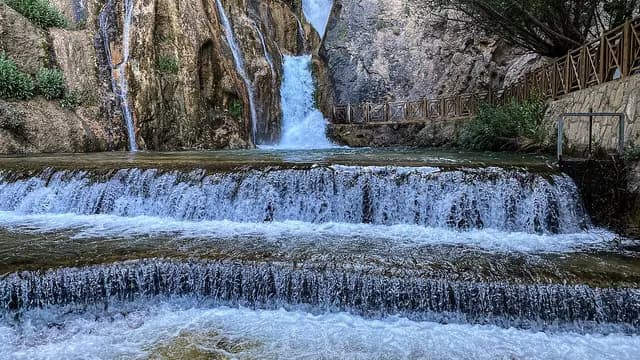
A valley in the Girmana neighborhood of Hekimhan, known for its steep slopes and stepped structure, with a recreation area and a walking path of about 4 km.
 Machine translated — This content was machine-translated and may differ from the original Turkish text.
Nature park
Günpınar Waterfall Nature Park
Darende, Malatya
A waterfall area declared a nature park in 2018, where the Şuhul Stream drops about 25 meters in three steps at the end of a narrow canyon.
- Machine translated — This content was machine-translated and may differ from the original Turkish text.
Tomb (türbe)
Tomb of Hasan Basri
Battalgazi, Malatya
A tomb moved to Battalgazi from the village of Korucuk, which was submerged by the waters of the Karakaya Dam Lake; also known as the Korucuk Tomb.
- Machine translated — This content was machine-translated and may differ from the original Turkish text.
Han and caravanserai
Hekim Han (Taşhan)
Hekimhan, Malatya
A Seljuk caravanserai that gave the district its name, begun in 1218 and completed in the reign of Alâeddin Keykubad I, famous for its inscription in Arabic, Armenian and Syriac.
- Machine translated — This content was machine-translated and may differ from the original Turkish text.
Tomb (türbe)
Tomb of İmam Zeynel Abidin
Battalgazi, Malatya
A tomb without an inscription, attributed to İmam Zeynel Abidin, son of Hz. Hüseyin, moved to near the Atabey Pier on the shore of the Karakaya Dam Lake.
- Machine translated — This content was machine-translated and may differ from the original Turkish text.
Tomb (türbe)
Kanlı Kümbet
Battalgazi, Malatya
A square-plan tomb with a brick dome in the old cemetery in Battalgazi, dated to the early 15th century, with a burial crypt on the lower floor and a tomb chamber above.
 Machine translated — This content was machine-translated and may differ from the original Turkish text.
Bridge
Kömürhan Bridge
Kale, Malatya
A crossing point on the Malatya–Elazığ road over the Euphrates, now the Karakaya Dam Lake, from the first bridge of 1932 to the new bridge opened in 2021.
 Machine translated — This content was machine-translated and may differ from the original Turkish text.
Canyon
Levent Valley and Glass Viewing Terrace
Akçadağ, Malatya
A valley stretching about 28 km, known as the 'Grand Canyon of Anatolia' for its hundreds of caves and steep cliffs, and a glass viewing terrace extending into the void.
 Machine translated — This content was machine-translated and may differ from the original Turkish text.
Museum
Malatya Archaeological Museum
Battalgazi, Malatya
A museum in Kernek displaying finds from Arslantepe and the Karakaya Dam rescue excavations, renewed after the earthquake and reopened in August 2026.
 Machine translated — This content was machine-translated and may differ from the original Turkish text.
House museum
Malatya Atatürk House and Ethnography Museum
Battalgazi, Malatya
A memorial house and ethnography museum in a cut-stone building in the First National Architectural style, used by Atatürk during his visits to Malatya in 1931 and 1937.
- Machine translated — This content was machine-translated and may differ from the original Turkish text.
Museum
Malatya Camera Museum
Yeşilyurt, Malatya
A large camera collection museum on Sanat Sokağı, displaying more than two thousand cameras from 1876 to the present.
- Machine translated — This content was machine-translated and may differ from the original Turkish text.
Museum
Malatya Radio and Gramophone Museum
Yeşilyurt, Malatya
A municipal museum in a two-story building in the style of a traditional Malatya house, displaying in chronological order radios and gramophones more than a century old.
- Machine translated — This content was machine-translated and may differ from the original Turkish text.
Archaeological site
Ozan Monument (Mescit)
Darende, Malatya
A Roman-period monument in the Ozan neighborhood of Darende, standing among apricot orchards near the Tohma River and called the 'Mescit' by villagers.
 Machine translated — This content was machine-translated and may differ from the original Turkish text.
Han and caravanserai
Silahtar Mustafa Paşa Caravanserai
Battalgazi, Malatya
A large Ottoman caravanserai with a courtyard and a covered section at the Alacakapı entrance to Old Malatya, built in 1637 by Mustafa Paşa, sword-bearer of Murad IV.
- Machine translated — This content was machine-translated and may differ from the original Turkish text.
Tomb (türbe)
Sitti Zeynep Kümbet
Battalgazi, Malatya
A Seljuk kümbet without an inscription in the Karahan neighborhood of Old Malatya, with an octagonal body and a pyramidal roof, dated to the 13th century.
 Machine translated — This content was machine-translated and may differ from the original Turkish text.
Madrasa and külliye (complex)
Somuncu Baba Complex
Darende, Malatya
Darende's most visited place of faith and culture, on the edge of the Tohma Canyon, with the tomb of Somuncu Baba, its mosque and its fish pool.
 Machine translated — This content was machine-translated and may differ from the original Turkish text.
Bridge
Suceyin Stone Bridge
Arapgir, Malatya
A historic bridge west of Arapgir that crosses a deep canyon on a high cut-stone arch, notable for its style differing from Ottoman bridges.
 Machine translated — This content was machine-translated and may differ from the original Turkish text.
Church
Taşhoron Church (Taşhoron Culture and Arts Center)
Yeşilyurt, Malatya
A stone church in the Çavuşoğlu neighborhood, built in the second half of the 18th century and used as a culture and arts center after restoration.
 Machine translated — This content was machine-translated and may differ from the original Turkish text.
Canyon
Tohma Canyon
Darende, Malatya
A canyon carved by the Tohma River in Darende, starting from the Somuncu Baba Complex, with wooden footbridges, small cascades, waterwheels and walking paths.
 Machine translated — This content was machine-translated and may differ from the original Turkish text.
Nature park
Turgut Özal Nature Park
Battalgazi, Malatya
A nature park of about 40 hectares declared in 2009 at Pınarbaşı, about 3 km from the city center.
- Machine translated — This content was machine-translated and may differ from the original Turkish text.
Castle
Zengibar Castle (Darende)
Darende, Malatya
A historic castle with a cut-stone gate rising on the steep cliffs west of the Tohma River, between the Somuncu Baba Tomb and the Ottoman cemetery.
Practical information
Machine translated — This content was machine-translated and may differ from the original Turkish text.- Note
- Restoration is ongoing at some historic buildings affected by the February 6, 2023 earthquakes; check the current status before your visit; see muze.gov.tr for museum and archaeological site hours
- Climate
- Continental climate; summers are hot and dry, winters cold and snowy
- Best time
- April–June and September–October; the apricot harvest is in midsummer
- Getting there
- Malatya Airport is northwest of the city; there are road and rail connections from Ankara, Sivas, Elazığ and Kahramanmaraş
- Getting around
- Buses and trolleybuses in the city center; Arslantepe and Battalgazi are close to the city, while Darende, Akçadağ and Arapgir require a private car or district minibuses